Showing posts with label dartless knit tops. Show all posts

Thursday, December 15, 2011

PMK, darts vs no darts

Before, I mentioned that I generally choose the DARTED silhouette instead of using the NO DART choice, even when I plan to sew no darts. Here, I hope to show you why.

Below, I have superimposed two patterns...each using the identical measurements and settings EXCEPT, the RED one chose a SIDE DART and the blue/green one used NO DART.

With both pattern sets aligned at the shoulders, you can see that the front pattern is almost the same, with or without the dart.

But look at the back patterns. The no-dart pattern (in green) has a shorter back armhole depth than the darted one (in red).
But that isn't all...look at the overall length of the back patterns.

When I align the pattern sets, matching at the waist and hem, you can easily see that the back pattern of the NO DART set (green) is actually LONGER than the one that uses a dart (red), even though BOTH pattern sets were made using identical measurements!
PMK shortens the back length when a 'dart' is chosen.
I have adjusted my BACK length measurement to be longer than 'real' so that when it is shortened to use with the darted pattern, it will still be adequate.
Of course, this was NOT discovered before I sewed that last 'dud' I mentioned before...

I had assumed the overall back length of my newly-sewn top would be just the same length as the back of the previously sewn knit tops if I used the same measurement!

But no, that isn't the case when darts are chosen for one pattern but not the other.

But as I said, this is a recent discovery... sigh.

But to me, the real issue with the no-dart choice *is* the change to the upper back...that raised back armhole level. The upper back is now shorter from the underarm level up to neck.
My no-dart garments will pull to the back, trying to borrow fabric from the front. This happens because the back armhole height is too short...the distance from underarm level to the back neck on the pattern was reduced.

Also look at the sleeve. The shortened back armhole creates a sleeve with a smaller back half. This contributes to the "pulling-to-the-back" and a general feeling of tightness. When the back armhole is smaller, the back of the sleeve is smaller...there is less fabric there.

Also, this narrower sleeve's cap height would need to be made shorter to maintain the same bicep measurement across the sleeve as on the darted one...and that lowered cap height can introduce pulls that might not be there if the darted bodice were chosen. In the example above, I did NOT change the cap height on the sleeve...and you can see that the two sleeves are NOT the same width.


But here, below, you can see what happens when I change the cap height on the DARTLESS top...reducing the cap height by 0.25" so that the bicep width on the sleeve is nearly the same as before. The patterns are aligned at the front underarm point (because the front armhole on both patterns is nearly the same, I choose that as my point of alignment for comparison).


Anyway, THAT is why I choose to use the DARTED silhouette, even when I plan to sew NO darts! YMMV.

Wednesday, August 10, 2011

Tiered-Flounce Top

This Spring I bought a top that I really liked. It was a tiered-flounce top from Coldwater Creek. It only came in two colors and I wasn't crazy about the other color they offered, so I decided to try to make myself another one by copying it. It seemed like it would be fairly easy to do...after all, it appeared that it was just a bunch of strips of fabric sewn to a knit base. Kinda.

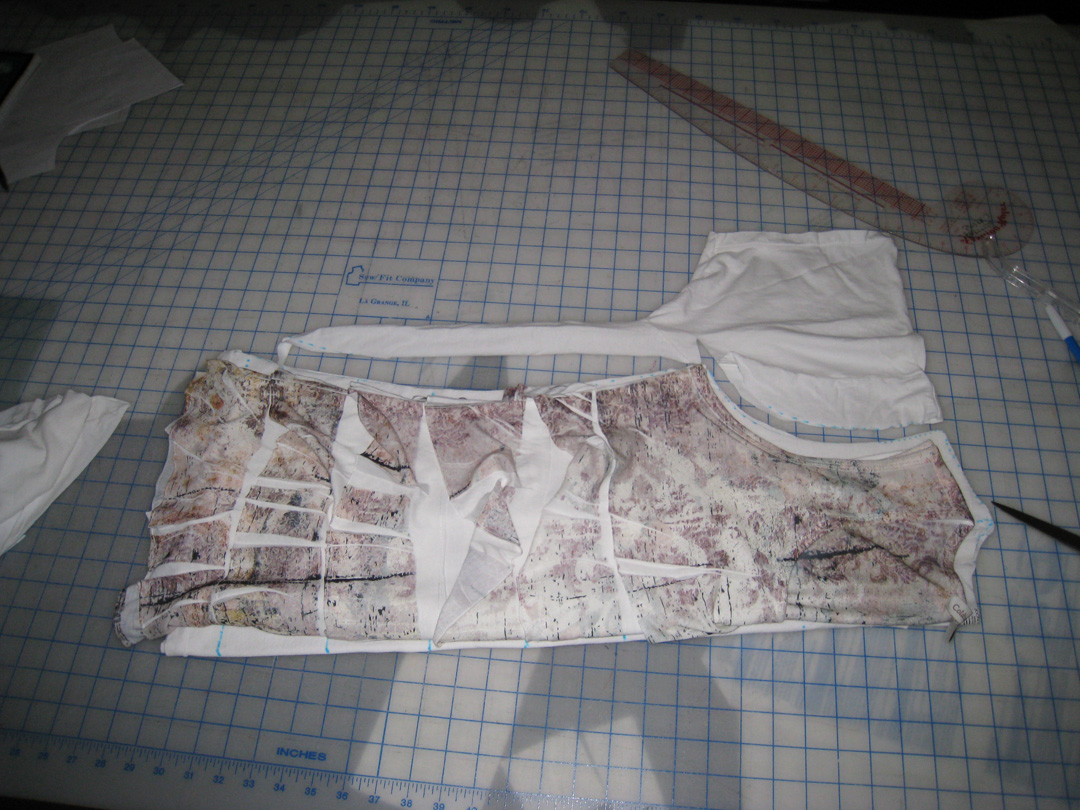
For my base, I found a men's XL T-shirt that was willing to be sacrificed...I mean, 'improved'. I straightened it out and folded it in half lengthwise. Then I did the same to the flounce top, which I layed on top of the men's T-shirt, aligning the center folds. Then, using my rotary cutter, I cut all around the outside of the top, leaving about a .5" seam allowance. I wasn't exact.


I cut the neckline for the higher BACK neck, but drew on the front neck, to be cut later (single layer). I also marked where the tiers should go.


Then I put this new 'base' onto a doubled sheet of paper and cut it again, so I'd have a paper pattern. I used ONE of the copies to create the tiers...I cut it apart on the lines I had drawn. To add flare to the tiers, I just slashed each one in several places and spread them open as I layed them on the fabric...I didn't bother to insert paper into the openings, as this wasn't a top I planned to make more than once.


Here you can see where I have spread the top tier...the one that includes the neck and shoulders. I was really just guessing at how much I should add...I wasn't even sure the original was flared! But this one would be.

Before I started cutting fabric, I suspected that I wouldn't have enought fabric...actually, I KNEW I wouldn't have enough! But I cut anyway...as if cutting would somehow create MORE fabric!

duh...
Sure enough, there was not enough fabric to cut all the tiers.

I went back to the store where I'd bought the fabric originally, but it had been many months and I didn't hold out much hope.

They didn't have any more.
But they did have this black and white spotty print and it was kinda neat so I got some of that to mix in.

I used my serger to put a lettuce-edge on the tiers, and used my coverstitch machine to attach them to the base fabric. Once all the tiers were added to the front and all the tiers were added to the back, I sewed the front and back together.

The neck and armhole edges were turned and coverstitched. I did trim away the base fabric in the neck and armholes so it wouldn't get too thick there.


Taking pictures of this top has been a trial! I have tried several times, and have yet to get any good ones! Sigh. I'll just share these...


Thursday, June 2, 2011

A Tale of Three Tee Shirts

It seems like every year when the weather begins to turn warmish, I start making knit tops. Generally, I use PMB, even though it is not designed for knit fabrics nor for dartless styles. But ever hopeful, I try again and again to modify the measurements and settings within the program, trying to produce the perfect knit top pattern.

Fast Forward: Earlier this Spring, Wild Ginger came out with a new pattern drafting program for knit fabrics, Pattern Master Knits. Well, duh…of course I had to get it!

I read the WG forum for a few weeks before I actually started using the knit program and learned which setting choices were being used by those who were having success with the new program. Eager for success, I drafted and printed a pattern.


For my first test top, I used some purple cotton interlock from my stash. I cut it out and quickly sewed the shoulders and sideseams, then tried it on. The shoulder angle seemed fine; the shoulder placement seemed fine; but I had the shoulders too wide and the CBL too long, AND, I felt like the sleeve cap was WAY too low...the sleeves were 'winging' out! (I had used +.75 for the cap height).


So I drafted a new pattern and recut the garment and tried again... reducing the shoulder width by .5” and the center back length by 0.5”; plus, I increased the cap height to 1.25”. Well, it was better…but then I thought that the underarm must be too high…the bodice was folding over, forming a pleat under my arms! Because the armhole was out on my arm...the bodice was encroaching on the sleeve's territory...I decided that I needed to reshape the F-ah by clicking downward about 10 clicks to scoop the lower front ah. So I made those changes within the drafter and reprinted and recut my top again. I continued to use the original fabric.


After sewing this new pattern, I began to think I should restore the wider shoulder I had originally started with!

Plus, in order to get enough front-length, I had to increase the CBL again…after reducing it before!...then move the shoulder-seam BACKWARDS (using the shoulder and neck-point settings) to put all the extra length into the front. There had been several updates to the program in the days/weeks between when I started on this top and when each iteration was done, and this made it hard to determine WHICH settings to use after each update! I was hopeful that, once Lisa (the programmer) got the bust-cup problem worked out, I would be able to get more front length without first adding to the back length (and eventually that WAS the case).

For all these patterns, I had used the NO DART option.

During the course of these trials, I also decided that the original shoulder angle was actually NOT fine as it drafted; even for a knit, the shoulder angle was way too steep for me. This seemed to be a common problem among the users, so in a subsequent update, Lisa added a shoulder height setting to allow the user to raise the shoulder tip on the front and back patterns. It's a good thing!


She also added a setting to allow forward-backward movement of the shoulder tip, to change the angle of the shoulder seam without moving the neck end. Another good thing!

Oh! The sleeves... As I said, I had read MANY posts on the forum to see what settings were working for the various people, and I read a post from tech support that said she was using a 2" cap height because she likes a higher cap. Well, the PM-KNITS program DOES draft with a really LOW cap height to start with, so I had also increased my cap height after that first iteration (where I had used +.75"...which, even at that, was 'raised' over the default cap height of 'zero'). I was using 2" cap height on my sleeves. Note: this is a clue to the eventual solution! :)

I was also aware that the back of the sleeve seemed to lay on my arm (a problem I have had before). I wondered if scooping the back armhole lower might be the key to getting a fuller back-half on the sleeve...?

By now, I was running out of this purple fabric...I only had enough scraps left to try ONE more set of short sleeves, still using the same bodice pieces which were getting shorter and shorter as I pulled them up at the shoulder to recut each time.

So, I decided to pull out a new fabric and try starting over! Based on my evaluation of the previous iteration of the purple top, I made various changes to my numbers and settings and set about drafting the new pattern for use with a pink floral fabric (which, BTW, I HAVE used before!).


On the purple top, the armhole seam was farther out on the arm than it should be, and the top felt kinda tight-ish across the high bust area. So, for this new pattern, in an attempt to reposition the armhole seam to get it OFF my arm, I had scooped the front armhole inward/ downward (using the armhole shape tool) and this made the length of the front armhole seam longer. When I added the sleeve, it was obviously wrong. The hem of this short sleeve was NOT level when viewed from the side. And like the others, arm movement pulled at the bodice.


Sigh.


Rotating and pinching and repinning and evaluating that sleeve, I could see that if I trimmed off 0.75" at the front of the sleeve, it would be more level.

But then I'd have to EASE the lower front armhole to the sleeve to control the size of that large front armhole.

I decide to look into using the DARTED style, instead of the no-dart one I had been using.

Here is the deal:
I had decided I needed more height in the front bodice, above armhole level, to eliminate that ‘armhole encroachment’ on the arm. So I ended up lengthening my CBL, (which lengthens both front and back, just as cup-size change does)...but then I used the tools to move the shoulder seam BACKWARDS. This put all the extra length into the front armhole.

But who wants a giant front armhole? Not me.
But I needed the height in the front pattern. Hmmm.

My solution for the giant armhole was to (manually) remove 0.75" off the front sleeve and then ease the front armhole to the lower front sleeve. It seemed to be the solution to the larger cup-size/big armhole issue, and it worked ok.

But that got me to thinking…If the sleeve I need should be .75" smaller in front, then the front armhole should also be .75" smaller…which just happens to be exactly what happens when I choose the DARTED version instead of the no-dart one!

So, rather than ease that extra fabric in the 'no-dart' style's front armhole to a modified sleeve, I decided that it would be better to use the DARTED STYLE and ease the fabric from the bust dart into the sideseam!

So I went back to the drawing board...drafting another new pattern.

I had been using the C-cup in my no-dart tops. For the darted top, I decided to use the D-cup draft, which produced a smaller front armhole than the C cup draft (bigger dart but smaller armhole).

*(Remember, this was early in the program's release, and the drafting bugs were still being worked out..however, 'we' the users, never know what will change in the future and what will stay as-is within the program, so I always assume that this is the way it will work and go from there. But since then, the cup/armhole issues HAVE been addressed/ changed since these patterns were drafted.)*

Ok, so I drafted with a D-cup and used the side bust dart. Better, but not perfect. There was still this weirdness at the front armhole. It didn't feel quite as tight across the high bust as the purple one did, but it still pulled with arm movement. For this one, I used a cap height of 1.25" and a D cup/darted. I also used the wider shoulders again...16.25" BSW.

To change from the no-darted bodice to the darted bodice required me to align the new pattern at the front armhole of the originally-cut bodice, since it was lower. This meant the top would end up shorter than originally cut out. This happened many times when I made changes...the overall length was variable according to what was originally cut out.

Determined to get these armholes and sleeves worked out, I decided to do some comparing…to see what numbers I would have to change to duplicate the fit of my last PMK top (the pink floral) but with a reduced dart size. I wanted the armholes to remain the same height as on that one, but I was willing to lose a little front length in order to make the bust dart smaller, as the gathers at sideseam seemed too apparent to me.

WELL, LO AND BEHOLD…after that April update was installed, all I had to do was change the bust-cup letter to get the desired changes! Apparently, going from C- to D-cup will no longer increase the back length! Yay!!! Only the front length was affected!!! This was gonna make drafting so much easier!

After the April meeting of the Memphis Sewing Guild, I came home motivated to sew! I removed the less-than-perfect sleeves from my very first PMK test top (purple cotton interlock) and recut the shoulders and armholes a little, cut new sleeves, and re-sewed. Better, but still, there was this 'pulling' at the front armhole. I have tried a higher ah, a lower ah, scooping and not scooping! Yet still, the bodice wants to encroach on the arm's territory, there in front where I move my arm. Rats!

I decided to do another top...not just new sleeves, but starting over! I created a pattern that 'scoops' the front armhole LOWER, not inward...then I cut and sewed that one from some periwinkle cotton interlock.

Again, the f-ah bugged me.


FINALLY, it hit me...perhaps the cap height of these sleeves is the problem!!!(?)

Because I had read on the forum that WG's tech support person was raising her cap height up to 2", I had been raising the cap height of all my sleeves to 1.5"...this made my sleeve's bicep line 'level' when viewed from the front (no 'winging' out), so I assumed that cap height was 'correct' for me.

But then I got to thinking...
Perhaps that bicep line NEEDS to be unlevel in a pattern where some of the bust dart is in the front armhole? Perhaps this armhole NEEDS a sleeve with a lowered cap height? Perhaps these sleeves were just too narrow across the sleeve cap, and THAT is why the bodice is out on the arm...it is being pulled there!

So, I cut and inserted some new sleeves into the periwinkle top, using a cap height of 'zero'.
Yuk...they looked awful and had lots of folds of excess fabric!

But the 'pulling' at the front armhole was gone!!! Yay!!!
So I removed those sleeves and cut/inserted more new sleeves, this time with a cap height of .75". Better!


These new sleeves still had some excess folds, but I had chosen the STRAIGHT underarm seam. If I use the tapered seam to make the hem more narrow, it did help control the excess and made the sleeve look better...but I knew I was going to make these short sleeves even shorter, manually curving the hem upwards in the middle...kinda cap-like. Doing that removed any traces of the excess folds! Hooray!

At this point I was thinking that some of that scooping that I did to the front armhole might NOT have been necessary! Sigh. But that couldn't be undone.

I made the shoulder width narrower than my usual for these...15.5". Even though it started out wider (16.25" ), all the various alterations I did to that first (purple) one caused it to get narrower across the shoulders (due to cutting off the top of the shoulder to lower it)...so I had to go with what I had when drafting new sleeves to fit that armhole.

Because I had run out of the purple fabric, I couldn't make a new set of sleeves with the proper (lower) cap height for that top. I was hoping I could perhaps cut up some of the rejected sleeves to create a set of petal sleeves, but alas...there just wasn't enough fabric there to be used. But I decided to go ahead and finish up this top and wear it, despite the fact that the armholes and sleeves aren't just what I'd like them to be. Knits are very forgiving!

I pulled some polka-dotted rayon challis from my stash and cut a bias strip to trim the neckline. I did a twisted binding on the scooped neck...I quite like it! My first time to try this.


Because the top had gotten shorter and shorter with each iteration, I sewed a band with ties to the lower edge instead of hemming it. I used the coverstitch machine to hem the sleeves.


Even though I wasn't thrilled with the pink floral, I decided to finish it and wear it, rather than take it apart and try to make improvements...I could improve on the next one! I cover-stitched the sleeves and hem, as well as the turned-under neck edge.


The periwinkle top was finished with a band of self-fabric at the neck, with cover-stitching at the sleeve and hem. But it looked so plain...so sporty. And it had gotten kinda short, too. There was nothing I could do about the short length, but to combat the plain-jane sporty look, I added folded flowers made from ovals of the cotton interlock along with some same-colored beads (both round and cubes). I like it a lot better now!


What did I learn?


  • Well, although the front armhole does need some reshaping, I did way too much. I can see (now) that lowering the sleeve cap height to +0.75" adds about the same amount of fabric to the front of my sleeve as I was scooping off the bodice at f-ah...and having that extra fabric on the sleeve would prevent the sleeve from pulling the bodice up there!

  • Also, when I overlay my F and B shoulder seams as if they were sewn (so that you can see the whole armhole shape), the armholes form a 'V' at the shoulder. I need to manually extend the shoulder seam to smooth the armhole curve. [I explored increasing the shoulder width measurement (which would extend the length of the shoulder seam) and reshaping the armhole with the tools, but I can see that I am better off leaving the BSW at 15.5" and manually redrawing the shoulder to add .375" at the tip (front and back), because the ah shape is just not right otherwise. This is easy to do, if I can only remember to do it! And actually, 15.5 is what my BSW *actually* measures if I measure as directed in the guide...straight across at the top of the back shoulder. That doesn't account for my shoulder blades, but it is a 'real' measurement!]

  • Over and over, I have increased the cap height to correct the hang of my sleeves, both in PMB and in PMK. But if I just extend the shoulder tip (manually) to eliminate that little V that forms, the sleeve won't have to reach up so far and I won't need a taller cap! If only I could go back to the very first iteration, where I actually started with a cap height of 0.75"!!! Sigh. Although, that one had other issues...

  • I think I like the waist higher than usual on my knit tops, which means using a reduced CBL.

  • And finally, I have learned that it is really hard to remember what I did when I wait so long to blog about it!


Although these tops were really 'lemons', I made lemonade of them all and do wear them in public!


And if you made it to the end of this very long post, then THANK YOU very much!


Saturday, June 12, 2010

The Red Floral KK knit top

Here is my latest knit top:


This pattern was made similarly to the black and white one, except this time I didn't lower the front shoulder angle.

I DID reduce both the CENTER FRONT LENGTH and the FRONT SHOULDER SLOPE measurements by 0.5", though, because I knew the knit fabric would stretch to accomodate my body's curves in front...and using a shorter CFL produces a smaller bust dart, so there is less dart to 'get rid of' from the start.

I also INCREASED my BUST measurement from 41.5" to 42"...not much, but this also made the bust dart smaller, so there was less dart to eliminate in the process of going 'dartless'.


Also, I INCREASED the SHOULDER LENGTH measurement in my chart for this one...because when I rotate that remaining little dart closed, it increases the width of the neck opening on the front pattern. By increasing the SHL I have created a more-narrow front neck to start with, so that when I rotate the little dart closed, the resulting front neck width matches the back neck width.


I DID NOT scale this pattern at all...I used it as drafted, with zero bust ease. In hindsight, I *should* have used MORE hip ease, then scaled it smaller, because I had increased both the shoulder and bust measurements! duh. But it is very wearable...the ladies in my sewing guild liked the extra ease. BTW, the back neck depth is 0.75".


There is a bit of 'drapery' under the arms, both in front and back. Part of this is the excess bust ease, but also, part of it is due to the shoulder angles being the same as for WOVEN fabrics. I should have lowered the shoulder angle after all! I have decided that for next time, I will lower the back shoulder angle by .375" and will lower the front shoulder angle by .75"...twice as much in front as in back. You can see by the picture below that when I pinch the shoulders UP, the drapery is lessened.


So, I *think* I have finally figured out how to get a good dartless pattern using my Patternmaster Boutique software! Yes, it takes some manipulation, but not alot...and certainly much less manipulations that I have to go through to alter a commercial pattern! And it only took 11 years to figure it out! ;)

Oh, and the 'KK' in the title stands for Klassy Katz...the fabric store where this fabric was purchased!
Here are my drafting choices:
Style Name: 100520_4_dartless_tiny_dart
Date: 5/20/2010
Last Update: April 1, 2010
Chart: Trish 050710_4Drtls_tinydt

Garment Type: Blouse
Style: Blouse
Closure: Front Zipper
Front Neckline: Scoop
Back Neckline: Jewel
Hemline Sweep: Straight
Hemline Shape: Straight
Front Darts: Side
Back Darts: No Darts
Sideseam Shape: Fitted

Front Waist Darts: 2
Back Waist Darts: 1

Front Neckline Depth: 4
Back Neckline Depth: 0.75
Neckline Width: 1
Neckline Point: 0

Armhole Depth: 0
Dart Override: -0.625

Side/Arm Point: -1
Side/Waist Point: 0
Side/Hip Point: 0

Cf/Extension: 0
Cb/Extension: 0

Shoulder Pad: 0
Shoulder Point: 0

Finished Cb/Hem Length: 24
Hip Depth: 8

Bust Pt Vertical: 10.25
Bust Pt Horizontal: 5
Upper Front Dart Length: 1
Upper Back Dart Length: 1
Lower Front Dart Length: 4.75
Lower Back Dart Length: 4.75
Back Shoulder Dart Length: 3


Sleeve Style: Set In
Sleeve Underarm Seam: Tapered
Sleeve Hemline Shape: Straight
Sleeve Length: Short
Sleeve Cap Ease: 0.35
Sleeve Underarm Length: 2
Sleeve Overarm Length: 7.849
Sleeve Hem Circumference: 15
Sleeve Elbow Depth: 8
Sleeve Elbow Circum.: 10
Sleeve Cap Height Adj: -0.75
Front Armhole Shape Down: -0.3 clicks
Back Armhole Shape Right: 0.2 clicks


Seam Allowance: 0.375
Hem Allowance: 2
Facing Width: 2

Chest Ease: 0
Waist Ease: 0
Hip Ease: 1


Body Measurements

Chest Circumference: 42******increased by 0.5”
Back Shoulder Width: 15.75
Neck Circumference: 13
Natural Waist: 35
Hip Circumference: 41
Crotch Length: 29
Height: 66
Weight: 98:)
Bra Cup Size: D
Center Front Length: 14.5***reduced by 0.5”
Front Shoulder Width: 15
Front Shoulder Slope: 18***reduced by 0.5”
Shoulder Length: 5.375**********increased by 0.375”
Center Back Length: 16.5
Back Shoulder Slope: 17.875
Bicep Circumference: 12

Notes:
duplicating/improving NOVeDrtls6 CSL2

DARTLESS 4 has 42 bust and longer SHL...which makes Fneck .5" narrower than Bneck...so rotating bu dart closed will equalize the neck widths

Tuesday, June 8, 2010

As happens every summer, I am once again sewing DARTLESS knit tops. I am once again trying to create the perfect dartless pattern, which will create the perfect dartless top. Again.

This one is very similar to a pattern I created a few years ago which pretty closely duplicates a Coldwater Creek short-sleeved knit top.

Basically, the pattern's front shoulder point is dropped severely, as if the side bust dart was scooted upward and removed at the shoulder! Of course, that is NOT what I did. No, I spent hours (days? weeks? years?) figuring out which numbers to change so that the program would create this shape for me!

The RED pattern (below) is the pattern for the above top. The blue/green patterns are my basic block, using similar drafting choices as were used for this one...for example, with the bust dart in the front armhole. You can see how the RED pattern has a very dropped front shoulder, yet the back shoulder remains unchanged. To prevent that front armhole from being WAY too small, I used the DART OVERRIDE tool to put some of the bust dart into the front armhole. As you can see, there is not much change in the sleeve, which means there is not much difference in the armhole lengths between these two patterns.


Below, the same two patterns are aligned at the hem/waist. As you can see, the front pattern is shorter on the RED one than on the basic block...this is because I reduced the CENTER FRONT LENGTH measurement to account for the stretch of the fabric.


I know that the front of my body will stretch the knit fabric more than the back of my body, so I can get more length from a knit fabric than I would get from the same cut-length of a woven fabric. So I can reduce the length of the front pattern to start with.
Also, as mentioned before, to lower that front shoulder point I reduced the FRONT SHOULDER SLOPE MEASUREMENT even more than I reduced the CFL...to increase the angle of the front shoulder. This is to prevent 'sagging' of the knit on the side of my body.
But as you may have noticed, this pattern is NOT dartless. There is a little dart there in the front armhole. Yet, I want a DARTLESS pattern! So the rest of the patternmaking was done in the PATTERN EDITOR.
I simply extended the dart to the CF line then rotated out HALF of the dart width. Then I drew a new CF line to connect neck and hem. The remaining dart will be eased to the sleeve...or ignored! This dart-rotation DOES remove a little width from the front pattern at bust level. And if you look back up at the top two pattern images, you might notice that the RED pattern is narrower at bust level than the basic block to start with! That is because I also reduced the BUST CIRCUMFERENCE measurement by 1.5". As it turns out, that was too much, especially when combined with this alteration which also reduces the width at bust level. But the top is wearable, even if the fabric is not gorgeous.


Speaking of not-gorgeous fabric, I am thinking I will over-dye this, and maybe print/paint on it, too. I mean, really, with my brown hair turning grey, I really don't need to wear a little black and white print that kinda reads as grey! Actually, this is not as bad on me as some shades of brown are these days!


This method DOES create a wearable dartless knit top and, as I said, it is VERY similar to the size, shape and fit of Coldwater Creek's knit top (size L). But it DOES ride backward some (just like the CWC tops) and I would like to eliminate that phenomenon.
I have created and sewn another knit top since this one, and I changed the way I treated the shoulder angles...stay tuned!

FYI, here are the drafing specs:

Style Name: dartless_with_tiny_dart
Date: 6/8/2010
Last Update: April 1, 2010
Chart: Trish 050710_2Drtls_tinydt
Garment Type: Blouse
Style: Blouse
Closure: No Closure
Front Neckline: Scoop
Back Neckline: Jewel
Hemline Sweep: Straight
Hemline Shape: Straight
Front Darts: Armscye
Back Darts: No Darts
Sideseam Shape: Fitted
Front Waist Darts: 0
Back Waist Darts: 0
Front Neckline Depth: 2.5
Back Neckline Depth: 0.75
Neckline Width: 0.625
Neckline Point: 0
Front Neckline Shape Up: 0.4 clicks
Front Neckline Shape Right: -0.4 clicks
Armhole Depth: -0.5
Dart Override: -0.625
Side/Arm Point: -1
Side/Waist Point: 0
Side/Hip Point: 0
Cf/Extension: 0.5
Cb/Extension: 0
Shoulder Pad: 0
Shoulder Point: 0
Finished Cb/Hem Length: 24
Hip Depth: 8
Bust Pt Vertical: 10.25
Bust Pt Horizontal: 5
Upper Front Dart Length: 1
Upper Back Dart Length: 1
Lower Front Dart Length: 4.75
Lower Back Dart Length: 4.75
Back Shoulder Dart Length: 3

Sleeve Style: Set In
Sleeve Underarm Seam: Tapered
Sleeve Hemline Shape: Straight
Sleeve Length: Short
Sleeve Cap Ease: 0.19
Sleeve Underarm Length: 2
Sleeve Overarm Length: 7.182
Sleeve Hem Circumference: 14
Sleeve Elbow Depth: 8
Sleeve Elbow Circum.: 10
Sleeve Cap Height Adj: -0.75
Front Armhole Shape Down: -1.8 clicks
Front Armhole Shape Left: 0.3 clicks
Back Armhole Shape Down: -0.5 clicks

Seam Allowance: 0.625
Hem Allowance: 2
Facing Width: 2
Chest Ease: 0
Waist Ease: 0
Hip Ease: 0

Body Measurements
Chest Circumference: 40
Back Shoulder Width: 15.75
Neck Circumference: 13
Natural Waist: 34
Hip Circumference: 42
Crotch Length: 29
Height: 66
Weight:
Bra Cup Size: D
Center Front Length: 14.5
Front Shoulder Width: 15
Front Shoulder Slope: 17
Shoulder Length: 5.125
Center Back Length: 16.5
Back Shoulder Slope: 17.875
Bicep Circumference: 12

Monday, March 15, 2010

Jalie 2794 via PMB, take two!


Here is my second attempt at creating this style using PMB. This one is better, but still not great. Style-wise, I think I have most of the 'moves' down pat...but the basic block I started with is still not perfect.

Remember how, on that last one, the armhole seams hung WAY off my shoulders? Well, even after scaling, they still do. My Front Shoulder Width measurement in my chart is 15.5" I don't know why. Here, I determined that using a FSW of 15" gives me the needed width across my upper chest. I don't remember when or why I increased that, but for the next one, it will be changed back to 15", and I'll reduce the SHOULDER LENGTH measurement by .25", too, to keep the front neck opening as-is.

Speaking of neck openings, what is up with my back neck size? At some point I must have decided to increase my NECK CIRCUMFERENCE measurement to give me a wider neck opening on the back pattern...it is much wider than the front pattern's neck width. They should be fairly close to equal, although the back CAN be wider to reduce the size of the back shoulder dart. I am sure this was my intent, because those back shoulder darts have been the bane of my existence since I began using PMB! I don't want huge back shoulder darts...they don't look right when I sew them, but my upper back is much wider than my upper chest, so they are necessary for controlling the length of the back shoulder seam.


Well, when the back neck is too wide, it allows the front shoulders to 'spread'...making the front neck opening as wide as the back neck opening...which then pushes the armholes out that much farther! So, in addition to a FSW that is a little too wide to start with, the neck is also contributing to this problem. You can bet I will change that for the next one!

For this top, I used the setting called NO BACK SHOULDER DART. It drafts no back shoulder dart (duh) and reduces the width of the upper back so that the back shoulders are the same width as the front shoulders. As you can see, the armholes in back are still WAY out on my arms. In experimenting with numbers (after sewing this) I found that reducing the Neck Circumference Measurement will cause these seams to move inward...next time.


As I mentioned before, I still think I need to increase the size of the bust dart by increasing the cup size I am using. I have gone back and forth with this...but after reading the book mentioned here, I am pretty sure the size and balance of the armholes is critical. I must get those right and use whatever dart size follows.


Here you can see the little fold that forms on the sides of my bust at the bottom of the front armhole. There is no corresponding fold in back...just in front. This leads me to believe that back armhole is too short for the front armhole (or the front armhole is too long for the back).

I also think I could have used less bust ease. I used 2" bust, 3" waist and 3" hip ease...then scaled the pattern 96%. I think once the armhole seams are up on the body where they belong, using a little less bust ease will be needed to pull the side at underarm inward, too.

I feel like this style is making me look VERY large and top-heavy! I am hoping it is just the too-wide shoulders and excess fullness at bust, but it could be that the horizontal gathers between the bust is just not my look.


To create this style, I started with the BLOUSE with the side dart.


I used a SQUARE neck,
Front Neck Depth =5.5", and
I reshaped it using the neck shape tools...
27 clicks up and 21 clicks left.
This gave me a sweetheart shape.


First, I extended the bust dart all the way to the bust point.

I located a point on the sideseam that was 2.5" below underarm level, and drew an arc from that point to corner of neck.

I located a point on the CF seam that was 5" below the neckline, then another point at its midpoint.

I also drew some GUIDELINES:


  • a vertical grainline in the shoulder area;
  • a horizontal line from BustPoint to CF;
  • and another front BP to lower armhole.
Then I removed the yoke area from the front pattern.


On the front pattern, I selected everything above the bust dart (blue) and rotated CCW, using BP as pivot point, to close HALF of the bust dart.

Then I selected only the side area of the upper front (green) and rotated again, using BP as pivot point, to close remainder of bust dart. This put HALF the bust dart into the Center Front and HALF into the seam that would join the yoke...to be eased.
*
*
*
*


I redrew the arc just to smooth it out a bit, then I measured and added notches to both the yoke and lower front.

The one thing I wasn't sure what to do with was that tiny vertical dart at the front neck. I planned to gather the upper center front, which would take care of the vertical excess created by the bust dart, but what about the horizontal excess? I didn't want to sew a dart or create a seam there.

Remember, I had located a point on the CF that was 5" below the neck. The bust dart added another inch. so rather than gather this 6" down to the original 5", I decided I would gather it to 4", and that would probably use up the horizontal excess, too.

Well, maybe it did and maybe it didn't.


Anyway, this is how I did it. I'll probably try this one more time, but I am not sure I love the horizontal gathers in the center front. Perhaps FEWER gathers? Perhaps keep them higher (not go all the way to the 5" point but stop at 4, maybe?


Although the waist darts are on the pattern, I didn't sew them.

Here are my drafting choices:

Garment Type: Blouse
Style: Blouse
Closure: No Closure
Front Neckline: Square
Back Neckline: Jewel
Hemline Sweep: Straight
Hemline Shape: Straight
Front Darts: Side
Back Darts: No Darts
Sideseam Shape: Fitted

Front Neckline Depth: 5.5
Back Neckline Depth: 0.75
Neckline Width: 0.25 ***(look how much wider the neck looks...even the added band width has plenyt of room. This is because of that back neck being too wide.)
Neckline Point: 0
Front Neckline Shape Up: 2.7 clicks
Front Neckline Shape Right: -2.1 clicks (I guess a 'negative' right click equals a left click?)

Armhole Depth: -1
Sleeve Style: Set In
Sleeve Underarm Seam: Tapered --(I might try the curved next time, but I was chicken.)
Sleeve Hemline Shape: Straight
Sleeve Length: Wrist
Sleeve Cap Ease: 0.32 ***(notice, hardly ANY cap ease!)
Sleeve Underarm Length: 20
Sleeve Overarm Length: 24.65 ***(yeah, I have gorilla arms.)
Sleeve Hem Circumference: 9.5
Sleeve Elbow Depth: 8
Sleeve Elbow Circum.: 13
Sleeve Cap Height Adj: -0.75*** (This will probably change when I get those armhole seams up ON my body!)

Saturday, October 10, 2009

Teal Tie-front Sweater

I am planning to attend the International Quilt Festival in Houston next week.


Yesterday, I decided I needed something to wear on the plane that I could take off if it was too warm, so I pulled out a UFO!

Back in 2005, I created a pattern for a tie-front sweater. I had even cut it out, but never sewed it...I had decided to wait until I got a coverstitch machine, to sew those edges.


Well, I have one now so I decided, WHAT THE HECK! Time to sew that puppy!


Yeah, the measurements probably aren't what I'd use today, and the pattern was created similarly to the dartless tops I have done (where the front shoulder is very steep...still haven't shown that pattern!)...but it was *there* so I sewed it!


It was almost fun!


I pulled it out of a box in a cabinet and serged it together with a 4-thread stitch in practically no time!


Then I machine-basted all around the edges at 3/8", to give me a line to follow to 'turn' under the edge for coverstitching. Before coverstitching, I mitered (on the sewing machine) the seam allowances at the points of the ties, then I pinned the edges under and coverstitched along the entire outer edge...including sleeve hems...and voila! it was done.


And it fits!


Well, kinda.


Good enough!


And took only a little time!!!


No ripping every other seam... :)


No I have to come up with something to wear with it!
 
Free Hit Counter