Showing posts with label sewing clothes. Show all posts

Friday, April 19, 2013

MOG Dress Construction, Pt 1

I had a difficult time deciding on fabric to use for my MOG dress.  There was not a huge selection of fabric at my local Hancock Fabric stores...I visited 3 in my area, as well as the Joann's Fabric store!  I really wanted to use silk, but that was not to be, unless I wanted a pale oyster color (which Klassy Katz had!).  I did not want pale oyster or any other pale color.  After trying on a gazillion RTW dresses, I knew I needed a strong color....preferably a jewel tone. 

The MOB had a teal dress so I could not use that.

I finally settled on a polyester crepe-back satin from the BFF line (by Lauren Hancock). There was a coordinating lace, but it wasn't special...not reimbroidered or anything. But this was the best I could do locally and I had procrastinated too long to shop the internet and send off for samples...so I purchased this grape hyacinth-colored fabric.  

As I was trolling the aisles, hoping to stumble onto something better before I had this cut, I spied an odd mesh fabric...it was both purple and gold!  I wondered...what if?

So I bought some of that mesh fabric as well!  I decided to use it UNDER the lace...that way, the dress would have some sparkle without my having to add beads!


I cut each layer of the bodice separately...that is, I cut each piece from 3 different fabrics, one fabric at a time.

As you can see, I bought more than enough fabric...there is plenty of gold mesh left over for more fun things!

And when the lady cut my 3 yards of lace (I only really needed 1.5 but had allowed for experimentation), she used her 'gun' to scan the price on the bolt and said, "Do you know how much this lace is?"
Oh dear, I thought.  "Yes, it is $9.99, but on sale for 30% off."
She was shaking her head, no.  She stuttered a bit..."It is 21---er--"...pause (my heart fluttered...21?)..."seventy cents per yard."
Both of us were sure it was a mistake, but she said she couldn't change it.  I bought all 8 yards!  and for less than the regular cost of one yard!  So I have lots of lace, too!


Once the layers were cut out, I carefully aligned each one and glue-basted them together around the edges. This way, once the glue dried, it could be treated as one layer.


Here you can kinda get an idea of what this looks like once the fabrics are layered.  The gold mesh really added a richness that the lace alone lacked.

I don't know WHAT I will do with all the leftover lace!

Here are the bodice pieces, front and back, all lined up as they fit together.  The FRONT pieces are on top, and the BACK pieces at the bottom.

I serge-finished the edges of the vertical seams before sewing these pieces together.

Turns out, that was not necessary, and was actually not helpful, so much of it was eventually ripped out.


Once the vertical (princess) seams were sewn, the seam allowances were clipped and notched to allow for spread.  This made it easier to remove the unneccesary serger threads!

The bodice pieces went together fairly fast and smoothly.  Then it was time to work on the midriff section.  so back to the drawing board...er, drafting program! 


Once the pattern was made for the midriff, I started to work. I found this woven fabric in my stash of interfacings...I think it was originally purchased to make 'rangers' for jackets...you know, those two pieces of interfacing that encompass the back neck and shoulder and one armhole...they cross in back, giving support and movement.

Anyway, I decided it would be a good foundation layer for my midriff.


I cut my midriff pieces from the woven fabric, then marked and sewed the darts.


How funny it looks once the darts force it to take shape!


Now, at this point, I wasn't sure exactly HOW I was gonna get the midriff done.  I tried DRAPING the fashion fabric over this foundation...for about 27 seconds...!  t
Then I came to my senses!  I am a flat-pattern thinker...my brain just doesn't like to drape.


But then I got a wild idea.


WHAT IF I pleated the fabric BEFORE I put it on the foundation?

I have a pleater board that I made several years ago...it was a sewing guild project and we all made one.  So I pulled it out and set to work.
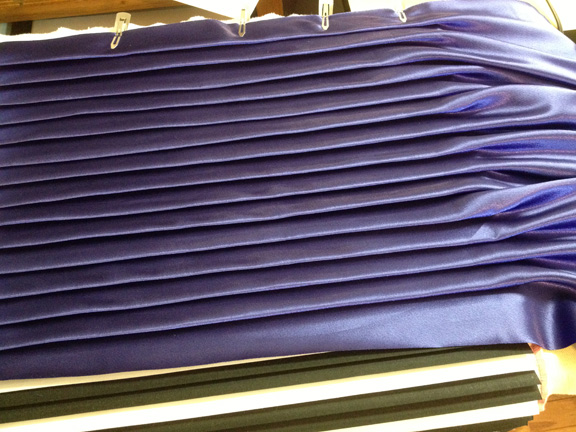

I put the right side DOWN toward the pleater board (I am using the crepe side, not the satin side, as my 'right' side) and began pushing the fabric under the 'lips' of the pleater board...skipping every other one.

Then, I used an iron-on tricot interfacing and pressed it onto the fabric to hold the pleats in place.
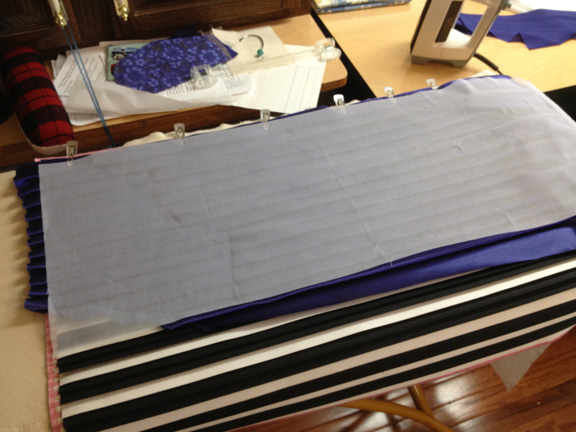


I did a wide section for the front, then two smaller sections for each half of the back. 
This took A LOT of fabric!

Once I had my pieces pleated, I began to consider once again HOW I was going to attach this to the foundation.

uh oh.

Even though I had cut this fabric on the bias before pleating it...so it would have lots of 'give'...it was still NOT possible to force this pleated piece to have the same shape as the foundation pieces. 

Rats! 

No, the dart shaping had to be incorporated. 
I went back to the computer and created a new pattern piece for the pleated midriff.

Since the Empire waist was 3" above the waistline and the midriff extended 6" below the waistline, my midriff section was 9" tall.  I divided that into 6 equal parts...1.5" each.

Then I separated the sections and added folding lines, then closed the dart fragments in each section.


I ended up with two sections with opposing curves which would be joined at the waist.

So I cut these pieces from some more fabric...again, placing them on the bias...and began sewing these pleats in.  I folded on the fold lines, then basted on the pleat lines.  Once the pieces were pleated I began hand-sewing them to the foundation.

It was awful.  The bias stretched, causing weird bumps.

So I decided it couldn't be bias.  AGAIN, I cut new fabric to try anew.  I was worried that I might run out of fabric...and I had purchased THE WHOLE BOLT...there was nothing left at the store to go back and get should I run out!

This time I decided to pleat the fabric ONTO the foundation.  I aligned the top edges and pinned.  Then I sewed on the fold line, then folded the fabric upward and pressed...then basted on the pleat line, and sewed again about 3/16th" below that...so that once the basting was removed, the pleat would stay partially closed.  Then I would press the fabric downward again and sew on the next foldline...etc. 

Well, when I got the second pleat done, I realized that the FIRST pleat didn't measure 1.5" as planned.  It was only 1.25".  I decided NO BIG DEAL...I would make the second pleat 1.375", then the third and remaining pleats would be 1.5" and no one would know the difference.

Well, the math didn't work out that way.  once I got to the bottom, there was too much fabric for just one pleat, but not enough space for two pleats with the correct spacing.  I had to start over yet again!

Each time I started over, I had to cut a new foundation...because it wasn't worth ripping out all those pleats to salvage the foundation!

So once again, I pinned the top edge to the foundation and began pleating the fashion fabric to the foundation...this time MEASURING VERY CAREFULLY!  Each pleat was 1.5" wide.

Once the upper section was done, the lower section was begun.
I sewed the waist of the lower section to the waist of the upper section and continued with the pleating.


I even added my machine's quilting guide to help make sure that each pleat was precisely sewn!

Once the midriff sections were finally pleated, I could sew them each to their respective bodice piece. 

FINALLY, it was time to put in the zipper!  My choices were limited...the best color match was not an invisible zip, but in the end I decided to use the invisible one.

I put in the zipper, stopping the top about 7" below the neckline.  I wanted a slit in back but wanted it to be short enough that the dress would cover my bra band!

Once the zipper was in, I could finally sew all the bodice pieces together, front and back, and try this thing on!  Yay!

Well, not yay.  It was too 'blousey' under my bust!  Ugh! 

Even though I had sewn a trial muslin, it was NOT an Empire waisted one.  And we all know that an Empire waist fits more snugly around the ribs than a top with a 'regular' waist.  I was pissed.

Just like in that Pleated Dress I needed to make the waist dart wider at its upper end!  I could pinch out 0.5" under each princess seam at the Empire seam.

I took it apart.  I resewed the lower end of the princess seam (below bust point) to remove additional fabric (0.5"). 

Plus, I had allowed a 1" SEAM ALLOWANCE at the bodice Empire seam (just in case) and had decided I needed to use it all. Well, once the midriff was sewn to the bodice, I DID NOT need that extra!  It was too blousey in length under the bust as well!  so, I also removed this excess length from the front bodice at this time.

Then I looked at that midriff section that I had painstakingly pleated (ad nauseum)...I didn't cry, but I should have!  No, instead I began ripping. 

I ripped the waist seam and the seams holding the pleats ABOVE the waist.  I was finally able to remove the piece of fabric that was the upper front midriff.

I could easily sew the waist dart of the foundation piece larger...basically, it was correct at waist and below, but needed to be sewn straight up from waist to the Empire seam.

Well, think about this....if the dart is wider, that means the SHAPE of the pattern piece that represents the fashion fabric  has now changed, too! So I could NOT reuse the fabric...I had to (yet again) cut another piece of fabric for this upper front midriff section!  At this point, I am measuring to be sure there is enough left to cut a skirt!  There was...

So, I folded out the corrected dart on the pattern and cut the new piece.  Now, HOW am I gonna do this...since the midriff was initially formed by sewing the pleats from the top down?  Basically, I had to sew a lot of it by hand. 

Funny...after hand-sewing for a while, I was thinking to myself, 'this is so much more ZEN than shopping for a dress.'  But I had to laugh at this thought, because only a few hours earlier I wanted to tear my hair out!

I resewed the front midriff to the front bodice.  But remember? I had allowed that 1" seam allowance on the bodice that needed to be removed...ON THE BACK, TOO! 

So, now I had to RIP OUT THE INVISIBLE ZIPPER and remove the excess 3/8" length on the back bodice....then resew the bodice and midriff sections and reinsert that zipper.

Eventually I got the front and back put back together with the zipper in...and it fit!  Now it was time to draft the skirt...

To be continued.

Friday, March 29, 2013

Zero-ease Torso Block

A friend asked about the measurements and settings I am using now to sew this dress.  I couldn't really give a short answer.  I had to do some research!

So...I guess I should back up a bit and start this story from the beginning.

After trying on a gazillion RTW dresses and being made to feel that my body is sub-optimal deciding I could do better, I decided to sew a dress.  I pulled out that red crinkle sheath and tried it on for evaluation.  I didn't trust the shoulder changes that I had made because that fabric was, after all, a crinkle rayon!...it has 'give'!  But the need to raise the waist level and increase the bust cup were undeniable.  So I set about creating a new chart and pulled out some fabric to test it.

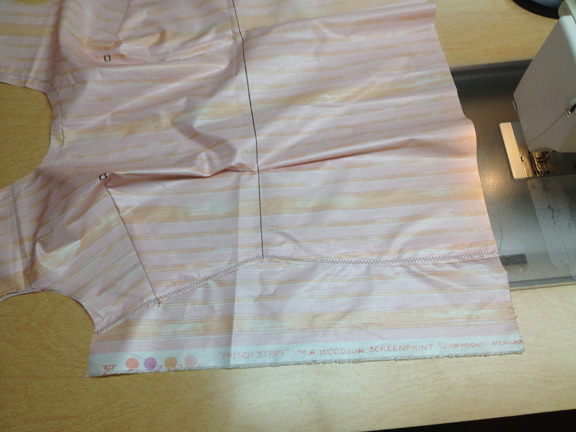
I used a striped polished cotton and cut a ZERO- ease torso block from it. 
I put a zipper in the back seam. 
No sleeves yet.
Well, as you can see by the pattern, there are some suspicious areas!
I used one waist dart in front and back.

I chose an F bust-cup.  Remember?...in the red crinkle sheath discussion, I decided that I needed to go up, but wasn't sure whether to go to E or F.  Since this was to be very fitted, I decided the F was the right choice.***Spoiler alert!!!  This decision will come back to haunt me!


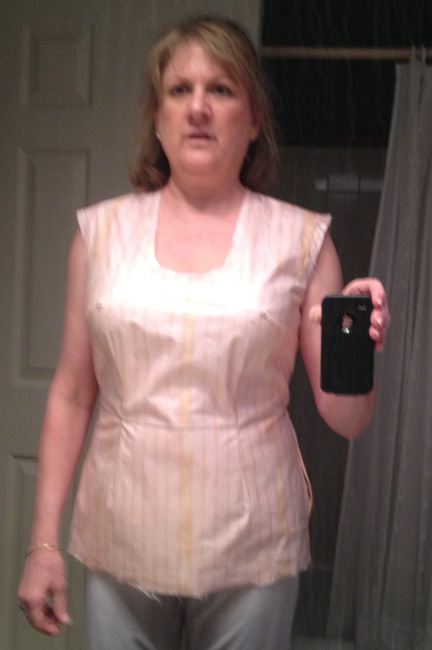
Look at how sloped that back shoulder is!  Way too sloped.  This was one of the changes that I made based on the red crinkle sheath that I was REALLY suspicious about...and it turned out to be way too much slope.

But at this point, I couldn't tell that, though, because I couldn't get this shell zipped over my hips!  I had used my hip measurement, taken at hip level.  But my body is larger at high-hip level!

Look at the hips on that pattern!  Very narrow.  But my hips ARE fairly narrow...
I decided to add some hip ease, then move the SIDE/WAIST and SIDE/HIP points so that ALL the ease I was adding would be in the back.  It seemed like that was were it was needed.

I took the shell apart and printed a new back pattern. I scabbed on some fabric to the sides of the back and re-cut it...then resewed it.  Bad!

I won't go through every detail of every iteration, but I did learn some things as a result of this exercise.
  • For one thing...I need for my waist darts to be very long.  These were way too short in the above pattern.  In front, my darts should be 8" long below the waist.  In back, the dart should be 7" long below the waist. 
  • My new hip depth is 9" since the waist was moved upward.
  • I should NEVER move the SIDE/WAIST and SIDE/HIP points on my torso garments!  I need to have the same amount of dart uptake in front as in back...and that amount is 2" per pattern.*
  • *In order to get waist darts that are large enough (to give me that 2" per pattern), I have to reduce my real WAIST MEASUREMENT by 2"...then manually add .5" at each side/waist to blend that sharp waist indention that PMB creates.
  • I should NEVER draft with 2 waist darts and only sew one UNLESS I am doing that front and back (maybe). I have to keep the uptake equal, F and B.
  • My front WAIST DARTS look better when I make the BUST DART HORIZONTAL setting a smaller number...4"...and increase the UPPER FRONT DART LENGTH SETTING to cause the dart to end farther from the bust point.  I chose 2"...This keeps the dart tip of the side bust dart in about the same place as before, but allows the waist darts to be closer to the center of the body for a more flattering look.
  • I use a ZERO setting for the UPPER BACK DART LENGTH SETTING. 
  • I use 3.5" for my  FIRST BACK DART POSITION setting....not sure this is set in stone yet.
  • To get under-bust contouring, I should sew the front waist darts straight up from waist for about 3.5"...then begin to curve in an "S" shape  before coming to a point.

Now, here is a VERY important lesson learned...I CANNOT use ZERO hip ease if my largest circumference is at the HIGH HIP ...especially when I also use long torso/waist darts!  I would either have to use the HIGH HIP MEASUREMENT as the hip measurement or add ease.  I chose to keep the measurement as is and add ease (for now).

I had to increase the hip ease setting to 3.5" to have enough width in the pattern to cover the high hip and  replace what I was removing in the torso/waist darts.  So, to create a "ZERO-EASE" shell, I  STILL have to add hip ease so I can dart it out with the long waist darts!  My body needs the interior darting for shape...it needs a wider pattern with more interior darting.

Eventually, I decided to go with 4.5" hip ease...this ease setting left me with 1" of actual hip ease, I think.  Once I went to the actual dress, I also added a tiny bit of ease to the waist as well.

Here is what my pattern looks like once I make all the right choices:

Notice the difference in the size of these waist darts as compared to the tiny ones in the original pattern (way up in this story).  The back shoulder angle is less steep now,**more about that later.

BTW, I raised this hem up a bit above hip level for the dress style...that is why it looks shorter.

***And, I DID have to make manual changes to the back neck and shoulder dart!***
Because PMB5 will not draft a back neck opening that is wider than the front neck opening,
I must manually slide the back neck over and reduce the size of the shoulder dart
I'll show that  in a future post.

Ok, here is a little about the fitting:

As you can see on the shoulder and armhole of this FRONT piece, I scabbed on some fabric at the very tip of the shoulder and have drawn marks where the armhole will be trimmed.  This is so I can continue using the same fabric piece without starting over...the next pattern has a wider shoulder, but I scooped the armholes by using the ARMHOLE SHAPE TOOL.

 
Below, you can see where I scabbed on a chunk of fabric so I could recut the front and add to the width of the hips and waist, according to the next pattern to be tried.

 
On my dress form, I hung a weighted string from the neck area, making sure it crossed the shoulder at the SHOULDER POINT.  This way, I could observe the side seam.
Notice...although it touches the string at the underarm and almost touches at the hip, the string is far behind the sideseam at the waist. 
Or, rather, the sideseam swings too far forward at the waist!
 
This tells me that my DART UPTAKE (and side seam position)  is not right...the distribution of the waist/torso dart uptake  is wrong.  The front darts are taking out too much fabric and the back darts not enough...and/or, I have placed the sideseam incorrectly. 
 
 
This was one of the iterations where I had tried moving the S/W and S/H points forward to allow the back to have more fabric over the bum.  Bad idea, but now I know!  Eventually, I realized that my darts much be equal front and back and my side/waist and side/hip must be at the zero position.
 
My pictures are awful...I know.  Shaky cell phone camera in poor lighting reflected in a dirty mirror.  But perhaps you'll get the idea--
 

The bust dart was too high and had an ugly ending.
The front waist darts were too far 'out', creating a plateau on my belly!


Funky dart tip...plus, look at the diagonal wrinkles behind that arm!

 
To eliminate those diagonal folds in back, I reshaped the back armhole using the ARMHOLE SHAPE TOOL.  First, I went back to my HELPING MEASUREMENTS as determined before.  I had measured my body from the shoulder point down the back armhole to the V where the arm meets the body...this measures 5".  I decided that the upper section of my back pattern also needed to measure 5", so I used the DOWNWARD ARROW to move the back  notch down until the upper section of that armhole measured 5".  This caused the back armhole to become more scooped.
 
 
I also increased my bust measurement by 1"...that is why the RED pattern is .25" wider at underarm level.  But the important note here is the lower notch on the RED one...the upper section of the back armhole seamline is now 5" long (between shoulder and notch), which matches my body.  The arc of the armhole will start where my underarm actually is!
 
Here is an attempt at photographing that back armhole.  There are 5/8" seam allowances still on the armholes...but the wrinkles were better.  In hindsight, I also think I should have decreased the Back Shoulder Slope measurement by a little, as well as make the Back Shoulder Width a bit smaller, because, after all, this is a zero ease garment...I might have too much ease in the back shoulder.  Hindsight.
 
 
I DID NOT make the same change to the front pattern.  That is, I did not lower the front notch so that the upper part of the FRONT ARMHOLE would match the measurement on the front of my body.  I tried, but in PMB, that causes the lower arc of the front armhole to become WAY too scooped.  So I just lowered it as far as looked 'right'.
 
 
Remember, the bust dart was too high.
So I lowered it.
Then I raised it up a little. 
Then lowered it again...
 
 
I stopped it farther from the bust point.

 
I moved that dart up and down, in and out...

 
...but still, the awful fold at the end of the dart was present!

 
In the end, I FINALLY realized it was the BUST CUP! 
I had used an F cup...
What if I only needed an E?
 
So I sewed a pleat across the whole front to similate how it would be had I used an E cup...

Better! 
I hadn't thought the front waist was too low, but once it was higher, it DID look better! 
(Using an F-cup also adds 3/8" more front length.) 
Moving the front waist up that 3/8" (by reducing the cup size) was actually an improvement!
 
I also considered that perhaps a single side bust dart would not ever sew smoothly. 
I am hoping that will not be the case!
 
 
I KNOW the darts look awful in this...I would normally sew 4 front torso darts instead of only 2, as well as 4 back torso darts...but on this shell, I was going for speed not beauty.
 
 
At this point, I decided I was close enough and started designing the pattern for the actual dress.
 
NOTE...I decided to raise the front neckline just a little for the dress....this one still has a 5/8" seam allowance on it and seems like a good depth, so I raised it for the real thing.
 
I guess I should post some measurements and settings, although I am not entirely sure what I should post!  I made more changes based on sewing the dress and would probably make the shoulders even more narrow!  See, I go back and forth on the best way to handle that 'V' that forms at my shoulder when the front and back are sewn together at the shoulder:
If you zoom in close, perhaps you can see the inward-V that forms there.
It will pull the tip of the sleeve up into it, creating a point.  I hate that!

So, I draft with the shoulders extra-wide, then use the ARMHOLE SHAPE TOOL to bump the notches INWARD on both front and back.  I have also drawn an ARC to smooth the upper armhole, creating a nicer transition from front to back.

I have tried using a narrower shoulder measurement, but forgetting to manually extend the shoulder tip to prevent the V is a problelm for me!  By doing it this way (drafting wide and trimming), if I cut out the garment BEFORE I remember to make a modification, I am still ok...I don't have to ADD anthing to fill in the little V...if I forget to scoop out around it, I will see it as soon as I set the sleeves...and can still fix it. 
This is still not set in stone!
 
 
Ok, if you are still reading, this is what I ended up deciding was my "zero ease" block.
 
HTH!
Patricia
 

Style Name:    130320_sleeveB_4_MOG_DRESS

Chart:    Trish_EcupShrtr _130306G_WA

Program: Boutique x5

Date:     3/20/2013


Garment Type:                  Sheath

Body Shape:                      All

Difficulty Level: All


Style:                                   Classic

Closure:                              Back Zipper


Front Neckline:                Scoop

Back Neckline:                  Jewel

Front Neckline Depth:     5.5

Back Neckline Depth:      0.5

Neckline Width:                0.5

Neckline Point:              0

Front Neckline Shape Up:              0.7 clicks

Front Neckline Shape Right:          -0.3 clicks


Front Darts:                       Side

Back Darts:                        Shoulder

Front Torso:                       1

Back Torso:                       1


Dart Override:                   0

Bust Pt Vertical:                              10.5

Bust Pt Horizontal:                          4

Upper Front Dart Length:              2

Upper Back Dart Length:               0

Lower Front Dart Length:              8

Lower Back Dart Length:               7

Back Shoulder Dart Length:          3

First Back Dart Position:                3.5


Sideseam Shape:                             Fitted

Armhole Depth:                               0.25

Side/Arm Point:                               -1.25

Side/Waist Point:                            0

Side/Hip Point:                               0


Cf/Extension:                                   0

Cb/Extension:                                  0


Shoulder Pad:                                   0

Shoulder Length:                             0


Sheath Length:                            Knee

Finished Cb/Hem Length:              22


Hemline Sweep:                         Straight

Hemline Shape:                          Straight


Hip Depth:                                         9


Sleeve Style:                                     Set In

Sleeve Underarm Seam:                Straight

Sleeve Hemline Shape:                   Straight

Sleeve Length:                                 Short

Sleeve Cap Ease:                             0.47

Sleeve Underarm Length:              2

Sleeve Overarm Length:                6.939

Sleeve Hem Circumference:         12

Sleeve Elbow Depth:                       10

Sleeve Elbow Circum.:                    10

Sleeve Cap Height Adj:                   -1

Sleeve Hem Width:                          1

Front Armhole Shape Down:         -0.4 clicks

Front Armhole Shape Right:          -0.2 clicks

Back Armhole Shape Down:          -1.1 clicks

Back Armhole Shape Left:             -0.2 clicks


Seam Allowance:                             0.625

Hem Allowance:                               2

Facing Width:                                   2


Chest Ease:                                       0

Waist Ease:                                       0.5

Hip Ease:                                           3.5


Body Measurements

Side of the Body:                             Left


Chest Circumference:                     42

Back Shoulder Width:                     17

Neck Circumference:                      13.5

Natural Waist:                                  31

Hip Circumference:                         39

Crotch Length:                                 29

Height:                                               66

Weight:                                              143

Bra Cup Size:                                    E

Center Front Length:                      14

Front Shoulder Width:                    15.5

Front Shoulder Slope:                     17

Center Back Length:                       15.5

Back Shoulder Slope:                      17

Bicep Circumference:                     12

Bust Radius:                                     4.5

Notes:                 

new- increased BSW by 1 and BSS by 1

and .5" to FSW

--reduced waist to 31


E cup

Use -1 cap height

Lower armhole depth .25


Free Hit Counter