Sunday, August 26, 2012

Cowl-neck Top with Cut-on Sleeves, part 2

As promised, here are a few pictures of me wearing the new cowl-neck top.

Yes, I cut off the top of my head in this one...using the timer and tripod to take pictures is always a learning experience! I decided this background was a bit too busy, too, so I moved over a little for the others.


The top performed really well in its real-life wearings! I have now worn this top several times and feel comfortable and presentable.

You might remember seeing these pants in my album over at the Wild Ginger Forum...these were made several years ago, but I pulled them out to wear since they matched this top. They have an elastic waist and inseam pockets. Made of rayon, this was a left-over Coldwater Creek fabric that was purchased from a jobber...or so I was told at the store where I bought the fabric.

Ok, yes, I was actually on the phone while taking these pictures! I use the SPEAKER function most of the time, so I don't have to hold it up by my ear...I was talking to my daughter. And yes, that IS a bandaid on my face. And, yes, my hair is lighter than before.


The sleeves are flippy and flirty and just right. They stay closed most of the time, but open with arm movement. They are not too large or long...just right. But then, I was copying a top and duplicated the sleeves on it, so I knew that in advance!


I had originally hoped the neck would drape a bit lower, but this turned out to be just fine. My necklace hangs free of the neck, and when I bend over it doesn't gap away from my body too badly. See?


All in all, this was a success! And it was fairly quick...not too many mistakes were made so I only had to rip a little.

Still basking in the glow of a sewing success, I realized I had more of this fabric left...another 1.5+ yards.
And the machines were still threaded with this color.
It only made sense to make ANOTHER turquoise slinky top!
Stay tuned...


Monday, August 20, 2012

Cowl-neck Top with Cuton sleeves

I have a RTW top that I have enjoyed wearing and decided I would try to recreate the pattern. I used PATTERNMASTER KNITS, from Wild Ginger, to draft my pattern.

After opening my saved settings for a basic top, I then selected the CUTON sleeve. It looked a little odd, but I could work with it.

Then I selected the COWL neckline. Oh dear. The front pattern reverted to 'normal' armholes while the back pattern maintained the cuton sleeve. Obviously, this is a bug that needs to be addressed.


I compared the front and back patterns of this cowl-necked pattern. When superimposed (below), I could see that the front (blue) was the same length as the back (red) from the NECKPOINT to the hem. The underarm points were at about the same depth. Hmmmm. That is NOT the relationship of my 'basic' top!

Apparently, choosing the COWL neckline eliminates the bust dart, but it reverts to the NO DART pattern, with its longer front pattern and its shorter back.


I looked at just choosing a BOATNECK instead of the cowl. Yes, both front and back had the cuton sleeve and the bust dart was still there.


Again, I flipped a pattern to superimposed front and back. As in my 'basic', the back pattern (green) is longer than the front pattern (red)from NP to hem, and the back armhole is larger than the front ah.


I knew I was going to have to redraw the sleeve and wondered how much difference there would be in fit if I just used the COWL-necked one, with its longer front and shorter back? I know this shorter upper back length makes the garment ride to the back when a sleeve is involved but this is essentially a sleeveless garment and with a heavy cowl in front, perhaps that would be a good thing? Plus, redrawing the cut-on sleeves would be easier if the front and back were the same!


I compared the two front patterns...still wondering.

After evaluating the RTW top that I was trying to recreate, I decided that its front and back were probably the same length, so I decided to go with the cowl-necked pattern, where the front and back patterns would start out identical.

I started with the BACK pattern. From measuring the RTW top, I knew I wanted my shoulder length to be 9", with the first 4.5" stitched and the remainder left as a slit. I just extended the shoulder seam at its original angle for 9" (rather than use the upward-angled sleeve extension that originally drafted.) Then I used the ARC tool to redrew the sleeve hemline from this new "shoulder" line to meet the side/underarm point.


Then I made a copy of the altered back pattern to use to create the new front.

I rotated this pattern off the center line (at hip) to add 2" width at the neckpoint level.

Then I leveled the hem by drawing a line from sideseam to center, which added a little length to the front.

I decided to also add a little extension to the BACK pattern to match!

Then I copied the COWL neckline extension from the other pattern and attached it to this new one.


After printing this pattern, I layed the RTW top onto the pattern to compare. There was a little bit of excess width between the underarm point and the waist...the sideseam needed to curve inward there, as opposed to being a straight line. So I modified my pattern and used it!


I cut this top from a 3-yard piece of turquoise slinky from my stash. This pattern with the cuton sleeve was just a bit too wide to fit the front and back pieces side by side, so there was a bit of waste in the layout. I folded and cut the front, then refolded before cutting the back to make the leftover width as large as possible so that it could be useful next time.


On the front pattern, I serge-finished all edges above about 2" below the underarm points. On the back, I serged the neck and shoulder edges. I waited to serge the sleeve hem until after the sideseam was sewn, so that I could continue down the sideseam to hem.


Although I could see no evidence of any stabilization in the back neck of the RTW, I decided to add some clear elastic to my back neck.


I used the coverstitch machine to stitch the back neckline in place. I also used it on the garment hem, but everything else was done on the sewing machine or the serger.

The shoulder and side seams were sewn on the sewing machine so they could be pressed OPEN for a few inches above and below the sleeves.

Although this wasn't how I did it initially, I had to rip and redo, so I'll draw in what I SHOULD have done! After pinning the front and back shoulders together, stitch from the dot at the neck point to the notch at the Shoulder Point. THEN fold the cowl extension over and sew again. I tried to do it all in one step but the neck edges scooted and came out uneven...so I ripped and redid.


Below, you can see how it looks with the cowl extension folded over to the back (before sewing).


The top is upside down here...with the neck and shoulder in the foreground...but hopefully you can see how it looks with the seam sewn.


I sewed the sideseams on the machine, then serged the edge of the back sleeves, continuing down the sideseams to serge them together from about about 2 inches below the underarm point all the way to the bottom edge. Above that 2" point, the sideseams are spread open to allow for the sleeves.

I used the sewing machine to turn and stitch the sleeve edges.


The color is not great in these last two...it is evening now and the skies are overcast, but using the flash just blows it out. Hopefully, you can get the idea!


I know you'd rather see it ON ME, and I will definitely add a picture when I get one! But for now, here it is on my paper-tape double, which, after my recent weight loss, is several inches larger than I am in the hips! but this is better than nothing, right?

The neck looks pretty good...

I made a critical error making this pattern though. Look at the side of cowl neck extension on the original pattern on the left.


If that extension was folded on the horizontal line, you can see that the sides of the extension (green arrows) DO NOT reach the shoulder seam! That means that the inside of the cowl acts like a 'stay'...it keeps the neckline from draping quite as much. But I WANTED the drape! This neckline is not low...I only added 2" when rotating the pattern...so I WANTED it to drape more! Plus, the RTW one that I was copying was as wide on the inside as on the outside. I didn't check that area when I made the pattern...just trusted that it would be 'right' and pasted it on!

The image on the right is how I should have adjusted the pattern...the green area. That way, when the extension is folded down, the outer edge of the extension is as large as the outer area of the neckline, allowing the neck to drape a bit lower.

Next time!

After using the coverstitch machine to hem this top, and realizing that it was SKIPPING STITCHES, I was pissed. It really didn't do a great job on the back neckline, but I didn't catch it in time to change it.

But the hem was unacceptable...it had to be ripped out!

Plus, I had allowed an inch hem allowance and that just seemed like too much. So after I ripped out the bad stitching, I trimmed off .25" all around and turned up .75" for the hem...better! I also trimmed an additional .25" at each side seam, as the hem seemed to be hanging long there. Better!

This was AFTER spending hours changing needles and adjusting settings until the coverstitch machine would finally stitch correctly.

The KEY turned out to be: 1)reducing presser foot pressure, and 2)reducing differential feed (it was set too high for this fabric after having previously adjusted it for a thicker, less stretchy knit). Changing the needles made no difference!

The front is a bit too long...remember, I chose to use the pattern where the front and back start out just the same. My 'basic' pattern would have a front that is slightly shorter than the back, and if I had started with THAT one, I bet it would have been JUST RIGHT! Next time...


Friday, August 17, 2012

Treasured Times, preview only

Back in October of 2011, I was asked to make an art quilt for a couple of friends of mine. They wanted it to be 6 feet wide by 3 feet tall; have greens, blues, browns, and a touch of red; and to reflect this time in their lives. I was thrilled and terrified! But I accepted...noting that I wouldn't even start on it until after the first of the year.

Well, in 2012, I DID start on it! And it consumed my entire Spring! I worked on this for about 6 months and on July 4th, it went to its 'forever home'. This piece is called 'TREASURED TIMES'.

I had planned to show the finished quilt and the entire creation process here on the blog, taking lots of pictures along the way to make that possible. But once it was finished and shown to my quilting friends, I was strongly urged to enter it in a quilt show.

I have never entered a quilt show before (although I have had two quilts in the AQS's ULTIMATE GUILD CHALLENGEs in the past!), and the idea is (again) both thrilling and terrifying!
But I decided to do it.
And that means that I can't show pictures of the finished quilt here on the blog! Not just yet.

But I will share a few images of the process, just to give an idea of what has been going on at my house! :)

This piece was done as a 'fiber collage'...I cut up small bits of fabric and used them like paint to create the image. Handling the bits was sometimes tricky; I found using a putty knife and/or tweezers made it easier to slip one bit under the edge of another bit. These were not stitched or fused...merely positioned on the batting until the whole background was sandwiched under black tulle for the stitching.


The background was created intuitively...I was not referring to an image as I created this fantasy place. I used chunks of colored construction paper to give me a sense of what shapes I might want the landscape to take.


I decided to include the faces of this couple, as well as their dog, on the quilt. I took photos of them on New Years Eve so that I would have something to work with...they were unaware!


The dog was fun to do, yet challenging at the same time. I had learned to do "portrait" applique from my friend, Vanessa, so I used that same method to create the dog, as well as a few other elements on the quilt. Here you can see the various fabrics I have chosen and labelled to use for the dog.


The dog and other various elements were created separately, to be applied to the quilt after the initial stitching. Various fibers and treasures were also included in this collage.


I created a pair of ducks to represent the oldest son...he is the Duckmaster at the Peabody Hotel here in Memphis. Each color was a separate bit of fabric! The foot is layered under a piece of blue tulle to give the illusion of it being under the water. I spent a whole DAY making these two ducks!


Now you can get a little perspective...those ducks are tiny! Each one is about 1-1.5"...tiny! But they were a necessary element!


I used beads to create the body for a butterfly for this piece. A good friend of mine gave me the black beads from her stash.


Here, the butterfly is sewn on the quilt. I tacked the wing tips so that the wings maintained a curve...creating some dimension.


The robin was a bit of fun! The nest was created from many tiny slivers of fabrics, cut and arranged then stitched.

Ok, that is all I can show you of this quilt for now.
I hope it isn't TOO MUCH! I plan to enter this in shows in 2013...after that, I can give the whole story!

Blogger dashboard has no icons

OK! I found the empty space on my screen that, hopefully, will allow me to upload photos! Here is a screenshot of my dashboard...there are no icons on that toolbar! How helpful is that? not very, I'll tell you. But if I mouse-over the area, a label pops up...better than nothing.
Let's see if this works. If it does, perhaps I can get on to posting about things I really want to talk about!

Changes make me ill...

Well, I am once again at the mercy of ever-changing technology that leaves me behind! I have finally got something to talk about here on the blog...only to find that Blogger has "upgraded" their "interface". I cannot figure out how to post photos! I feel like it must be here...yet my toolbar has no icons! I'll keep trying...check back, but don't hold your breath or anything!

Sunday, May 20, 2012

Where ya been?

I have been working in my sewing room....really, I have! But what I haven't been doing is blogging about it. Bad Trish! I will try to get it together, because I have lots to show and tell about this big project that I have been working on for MONTHS! Stay tuned...or maybe just check back! ;)

Friday, April 6, 2012

My Brown-Eyed Girl Quilt

At the November, 2011, retreat of my quilt guild, I took a class from Susan Cleveland. She taught us her 'piped applique' technique that she used on her 'Eye of the Piper' quilt.

I bought her PIPING HOT BINDING tool, as I could see it would come in handy, both for quilts and clothing. It is a clear plastic unmarked ruler with grooves on the underside near each long edge...the groove on one side is 0.25" from the edge and on the other side it is 0.5"
from edge.


This means you can cut the strips slightly wider and not worry about keeping the edges perfectly aligned when you fold your strip over the filler cord to sew...because you will use the tool to trim the finished piping to have a flange of the exact width.

The covered filler cord rides in the groove of the tool and the rotary cutter is used to cut along the adjacent edge to trim the flange to, in this case, 0.25".


Once the piping for this project was made, it was time to make the blocks.

The pieces are cut using layered freezer paper templates. There was one A, B, C, and D template for each block. I wanted to make more than one block at a time, so I made duplicates of the templates, allowing me to make 4 clocks at once.


After choosing which fabric would go where, the templates were ironed to my fabrics.

I cut out each shape, leaving a generous 1/2" along the curved edge but cutting the other 3 sides according to the template.


Then I began adding the piping to the curved edge of each piece.

I chain-sewed these pieces (not cutting the piping between templates) and used a small wooden skewer to help hold the piping in place as I sewed. Susan had lots of helpful tips for sewing these blocks!


Once the piping was added, the blocks were cut apart and sorted according to template.


I then turned the seam allowance of the curved edge and piping to the backside and pressed carefully. This leaves a little 'gap' between the template and the piping...perfect!


Now to assemble the blocks...


I used a waxy paper for wrapping deli sandwiches, which I purchased from Sam's Club, as my foundation. I cut the fabric rectangle that was to be the 'eye' and pinned it to the paper.


Then I used masking tape to position the template (to avoid having to pin through the 3-layered freezer paper!).


Then I carefully stitched in the ditch along side of the piping to attach this piece.


Once stitched, only THEN can the freezer paper template be removed!


I carefully folded back this layer to trim the 'eye' (rectangle) close to the stitching to eliminate bulk.


Then I smoothed the fabric back in place and added the next piece.


I continued to build blocks in this way...starting with template A, then B, then C, then D, until the block was completed.


See the masking tape to hold the piece in place for sewing...and the wooden skewer which helps spread the ditch open to sew in it.


The last piece of this block is ready to be stitched.


With each addition, the underlayers are trimmed to reduce bulk. But after the first layer, it is easier to fold the paper back and trim from the backside.


Here I am playing with the various finished blocks, trying to decide how I will arrange these and how many more I will need.


This is the final design. But even though I like it, it seems like it is not enough by itself.


I decide to make some stacks of chinese coins to put on either side!


After selecting the fabrics to use and sewing them together, I layered the pieces on the quilting machine to quilt.


Speacking of quilting, although I have no pictures of this part, this piece had to be quilted on the sewing machine instead of the longarm. The quilting consists of stitching in those same ditches that were stitched in as the blocks were assembled. Susan warned us about doing too much additional stitching, which will draw up the quilt, as the filler in the piping will not shrink up like the rest of the fabric and you can end up with 'mountains'.


So I spent hours stitching in those ditches...again! I thought how ironic this was...I was a new longarm owner and here I was, quilting on the sewing machine instead! boo hiss.


Once the two panels of 'coins' were made, I decided this needed a panel across the top...something to put a hanging sleeve on! I wanted to join all the various panels together using beads...so there needed to be a way to hang this without having the rod show.


I auditioned fabric for the top panel...trying to decide whether to use a dark strip within a lighter field or a light strip within a darker field.


The darker strip in the lighter field won out. But instead of a strip, I wanted a zigzag.


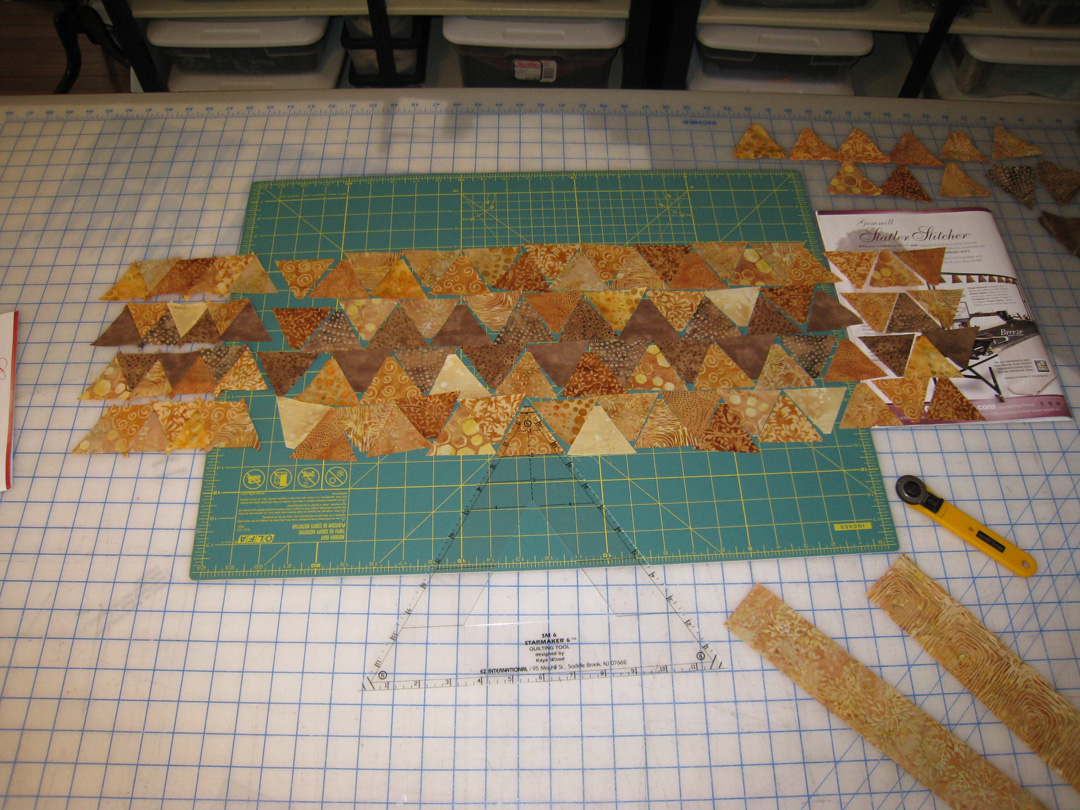
I cut little 60 degree triangles from some of the leftover fabric strips and arranged them in a pleasing way. Then one by one, these were sewn together.


I decided to put the piping around each section, between the binding and the body of the quilt.


I was now toying with the idea of hanging some stuff from the bottom edge.


(the clips are just holding the binding in place until it is sewn by hand.)


You can see my body as I hold the camera out over the table, trying to gain perspective. I have no design wall, so photos are the way I decide what to do next!


I settled on the distance I would leave BETWEEN each of the sections, then shortened the top section to accomodate that.


The finished quilt: Here, you can see some of the quilting, which really doesn't show much in the photos taken straight on. The top section holds the others with large wooden beads. There are bead spacers at intervals between the center and side sections.


I used cotton batting for this, but added an additional layer of polyester in the top section to create a trapunto-like affect. I stippled in the light triangles above and below the dark zigzag.


For the bottom of the quilt, I created 3 triangles. Two are 60 degrees, like the ones in the top, and the center one is 90 degrees. I used a product called INNER FUSE by Dritz, a double-sided stiff fusible interfacing. After cutting the triangles, I cut and sewed fabric to enclose them, leaving the upper edge to close by hand when the spacer-beads were added. The triangles also hang from the main quilt with beads. There is a wooden circle hanging from the center triangle and wooden and brass beads on the side ones.


The side coin strips also have a wooden circle at the lower edge. These circles were left over from a 'challenge quilt' I did before.


Here is the back of the quilt. You can see the minimal quilting in the main piece...just the stitching in the ditch around the 'eyes' and also, between the blocks.


Also, notice, the hanging sleeve has been added...this is laying sideways--the top is at the left of your screen.


And here is the finished piece, MY BROWN-EYED GIRL, which was a birthday gift for MY brown-eyed girl, Kelly.


Free Hit Counter