Thursday, August 4, 2011

Changes in the Sewing Room

Recently I have been doing some rearranging in my sewing room. I pushed my large cutting table off-center, toward the back wall.

I cleared out the pile of junk that had accumulated in the corner, and brought in a chair from another room.

The front wall, between the dormers, is completely void of furniture...the treadmill has been relocated as has the press.


The table that was under the window, which held the coverstitch machine, has been eliminated...it was just a card table and was always intended to be 'temporary', but at my house, 'temporary' sometimes is a long time! Now the coverstitch machine is sitting right beside my serger.


The whole wall is 'open' now...like a dance floor!


I removed all my fabric from these green cabinets and sorted through it... what I kept was rearranged/grouped and placed inside purchased bins for a neater appearance. The 'isle' between the cabinets and the cutting table is much narrower now, but I can still get the bins in and out, as well as open the doors on the island/cutting table and pull out the bins kept within.


I used to keep my ironing board right in front of the green cabinet, to the left of my sewing machine, so I could just pivot left and press when I was sewing. Now that the isle is narrower, I must find a new place for the ironing board!


The new light over the sewing machine is SO much brighter than the two mismatched lamps I had on my table before! I am no0t a huge fan of fluoroescent, but the light is bright and cool and it could be hung and plugged into an outlet. I REALLY wanted recessed lights, but that is a much bigger deal to provide!


So, "WHY," you ask, "are you doing all this rearranging?"

Because I have made a new purchase for the sewing room and it takes up space!


Yep, I got a long-arm quilting machine! Isn't that exciting? Well, it is to me! I have been dabbling with quilting for the last few years, and enjoy the piecing and designing but doing the actual quilting was always a challenge. Before, I have showed you the HandiQuilter frame that I was using with a Brother 1500 sewing machine...including the PVC handles I made to enable me to quilt from the front side.


But even with that set-up, I always dreaded the 'quilting' time, because I knew I would have trouble...skipped stitches, uneven stitch lengths, etc. It seemed to take forever to sew a tiny area.


Plus, the scale of the designs I could stitch was very small due to the size of the throat space on the machine.


So now, I can stitch larger designs!

I am still practicing, but am having fun!

I am now considering what lighting I will get for over the quilting machine. The fluorescent light made SO much difference over my sewing machine that I am considering getting a couple more to put over the longarm...but I hate the thought of all those cords and chains hanging down! But it is very apparent that I will have to get/make something...perhaps a light rail! :)


Monday, July 4, 2011

Summer Fun (?)

I'd rather do anything than alterations.


I may have started out the month of July by playing, but I ended the month of June with alterations.

Sigh.

Now that my son has finished Pharmacy school (and passed his test, BTW...hooray!), he needs to wear the longer lab coats that signify that he is a doctor, as opposed to a student. But his body-shape is as hard to fit as mine is! He also has wide shoulders that are out of proportion with the rest of his frame.
Yep, to fit his shoulders, he must buy a size 48...yet his chest is really only 44". His hips are 41" and his waist is 34" (strange, but his numbers are curiously close to mine!).

The size 48 lab coat is NOT an athletic cut. Instead, it appears to be made for a big man. My son is not big...he just has broad shoulders. I did not go with him to shop for this coat (nor any previous lab coats)...there are people there who know how to fit a coat (or so one would think).

Anyway, the last time he bought a lab coat...the shorter, student version...they altered it for him. It was hilarious. Apparently, all they did is take a bunch of pleats through the back waist...released pleats sewn right through the back waist band, that, from the back, made it look like he was wearing a full skirt! He did NOT want it altered that way again and asked me to please adjust the new one for him.

How could I say no?


Please...tell me! I HATE alterations!


But I agreed and told him to bring it over...the night before we were leaving town for the lake!


He put it on and I pinched and pulled, pinning and letting him move...trying to figure out if there was any way to bring those huge armholes any closer to his body. His range of motion was inhibited by the armholes being too far out on his arm. The TOP of the armhole...the shoulder point...was in the right place, but the armholes angled outward at the bottom and his body angles inward there, putting the mid- and lower armhole out on his arm.


Eventually, I realized there was no way I could really tell what I needed to do without ripping out the sleeve.


So I did. That was a bit scary!


In this picture, I have pinned in (on his left side) the alterations I hoped to make...to the right in the picture (the arm holding the pin cushion)...and the other side is unchanged as of yet.


I have pinned out 1.5" inches of chest width at underarm level. I pivotted the existing armhole shape inward to this new chest width and redrew the armhole, then pinned the sleeve to that. at this point, I had not CUT anything. I could still put it back like it started out! But he liked it and wanted me to continue.


Although you cannot see a huge difference yet (because only one side is pinned yet), you CAN tell that the underarm area is higher and closer to his body. And he could FEEL a huge difference/improvement!

From the back, the pinned-underarm looks higher, but still not as close as we desired. However, the sleeves weren't enough too-long to enable me to reshape the sleeve cap into one that was flatter (like adding a cut-on gusset)...so I couldn't reshape the armhole too much and still reset that same sleeve.

In this picture, the (adjusted) left arm is on the left side of the picture (still holding the pin cushion).
Also notice that there are pins in the center back at waist. I decided to change that straight center back seam into a shaped center back seam.

Crazy, I know...


...but I needed to remove so much fullness at the waist, and taking it ALL from the sides impeded his arm movement. He NEEDED the extra body dart that a shaped back seam provides. So the back waist had to be nipped in, too. I was NOT looking forward to that, because there is an applied band across the back waist, as well as a vent at the hem!

I needed to take in the side seams all the way from underarm to hem...1.5" at underarm, 1.125" at waist, and .75" at hip/hem. Once I began, I realized there are also inseam pockets...well, not really pockets so much as openings to allow access to one's pant pockets. I had to rip and reposition those inward too! Nothing was simple.


Here's that pocket:


Here is the back...you can see the applied band across the back waist as well as the vent at the hem. Both had to be ripped and redone.


I ended up having to also rip out the entire HEM so I could take in both side seams and redo the vent!


Below, you can see how I reshaped the center back seam...I have drawn my new cutting line with a blue pen. I moved it inward .75" at the waist, continuing straight down at hip/hem. That removed 1.5" of excess waist fullness across the back.


The front armholes were not reshaped nearly as much as they needed to be, but I couldn't enlarge the sleeve head to fit a larger armhole, so I had to work with what I had. I just traced the original armhole, then pivoted it from the shoulder point until the underarm point was at the new chest-width point. The blue lines are my cutting lines...using 3/8" seam allowances.


The back armhole was also adjusted just as the front...by pivoting the original ah shape from the shoulder point.


Here you can see how much chest width I planned to remove at the sideseams at underarm. Removing 1.5" on each side takes out 6" total!


Once I got it all put back together (just about 10 pm!) he was pleased with the improved look. He had more arm mobility than he started with, but not as much as he'd have with a properly fitted coat. So, of course, he wants me to make him one!

We'll see...

Thursday, June 2, 2011

A Tale of Three Tee Shirts

It seems like every year when the weather begins to turn warmish, I start making knit tops. Generally, I use PMB, even though it is not designed for knit fabrics nor for dartless styles. But ever hopeful, I try again and again to modify the measurements and settings within the program, trying to produce the perfect knit top pattern.

Fast Forward: Earlier this Spring, Wild Ginger came out with a new pattern drafting program for knit fabrics, Pattern Master Knits. Well, duh…of course I had to get it!

I read the WG forum for a few weeks before I actually started using the knit program and learned which setting choices were being used by those who were having success with the new program. Eager for success, I drafted and printed a pattern.


For my first test top, I used some purple cotton interlock from my stash. I cut it out and quickly sewed the shoulders and sideseams, then tried it on. The shoulder angle seemed fine; the shoulder placement seemed fine; but I had the shoulders too wide and the CBL too long, AND, I felt like the sleeve cap was WAY too low...the sleeves were 'winging' out! (I had used +.75 for the cap height).


So I drafted a new pattern and recut the garment and tried again... reducing the shoulder width by .5” and the center back length by 0.5”; plus, I increased the cap height to 1.25”. Well, it was better…but then I thought that the underarm must be too high…the bodice was folding over, forming a pleat under my arms! Because the armhole was out on my arm...the bodice was encroaching on the sleeve's territory...I decided that I needed to reshape the F-ah by clicking downward about 10 clicks to scoop the lower front ah. So I made those changes within the drafter and reprinted and recut my top again. I continued to use the original fabric.


After sewing this new pattern, I began to think I should restore the wider shoulder I had originally started with!

Plus, in order to get enough front-length, I had to increase the CBL again…after reducing it before!...then move the shoulder-seam BACKWARDS (using the shoulder and neck-point settings) to put all the extra length into the front. There had been several updates to the program in the days/weeks between when I started on this top and when each iteration was done, and this made it hard to determine WHICH settings to use after each update! I was hopeful that, once Lisa (the programmer) got the bust-cup problem worked out, I would be able to get more front length without first adding to the back length (and eventually that WAS the case).

For all these patterns, I had used the NO DART option.

During the course of these trials, I also decided that the original shoulder angle was actually NOT fine as it drafted; even for a knit, the shoulder angle was way too steep for me. This seemed to be a common problem among the users, so in a subsequent update, Lisa added a shoulder height setting to allow the user to raise the shoulder tip on the front and back patterns. It's a good thing!


She also added a setting to allow forward-backward movement of the shoulder tip, to change the angle of the shoulder seam without moving the neck end. Another good thing!

Oh! The sleeves... As I said, I had read MANY posts on the forum to see what settings were working for the various people, and I read a post from tech support that said she was using a 2" cap height because she likes a higher cap. Well, the PM-KNITS program DOES draft with a really LOW cap height to start with, so I had also increased my cap height after that first iteration (where I had used +.75"...which, even at that, was 'raised' over the default cap height of 'zero'). I was using 2" cap height on my sleeves. Note: this is a clue to the eventual solution! :)

I was also aware that the back of the sleeve seemed to lay on my arm (a problem I have had before). I wondered if scooping the back armhole lower might be the key to getting a fuller back-half on the sleeve...?

By now, I was running out of this purple fabric...I only had enough scraps left to try ONE more set of short sleeves, still using the same bodice pieces which were getting shorter and shorter as I pulled them up at the shoulder to recut each time.

So, I decided to pull out a new fabric and try starting over! Based on my evaluation of the previous iteration of the purple top, I made various changes to my numbers and settings and set about drafting the new pattern for use with a pink floral fabric (which, BTW, I HAVE used before!).


On the purple top, the armhole seam was farther out on the arm than it should be, and the top felt kinda tight-ish across the high bust area. So, for this new pattern, in an attempt to reposition the armhole seam to get it OFF my arm, I had scooped the front armhole inward/ downward (using the armhole shape tool) and this made the length of the front armhole seam longer. When I added the sleeve, it was obviously wrong. The hem of this short sleeve was NOT level when viewed from the side. And like the others, arm movement pulled at the bodice.


Sigh.


Rotating and pinching and repinning and evaluating that sleeve, I could see that if I trimmed off 0.75" at the front of the sleeve, it would be more level.

But then I'd have to EASE the lower front armhole to the sleeve to control the size of that large front armhole.

I decide to look into using the DARTED style, instead of the no-dart one I had been using.

Here is the deal:
I had decided I needed more height in the front bodice, above armhole level, to eliminate that ‘armhole encroachment’ on the arm. So I ended up lengthening my CBL, (which lengthens both front and back, just as cup-size change does)...but then I used the tools to move the shoulder seam BACKWARDS. This put all the extra length into the front armhole.

But who wants a giant front armhole? Not me.
But I needed the height in the front pattern. Hmmm.

My solution for the giant armhole was to (manually) remove 0.75" off the front sleeve and then ease the front armhole to the lower front sleeve. It seemed to be the solution to the larger cup-size/big armhole issue, and it worked ok.

But that got me to thinking…If the sleeve I need should be .75" smaller in front, then the front armhole should also be .75" smaller…which just happens to be exactly what happens when I choose the DARTED version instead of the no-dart one!

So, rather than ease that extra fabric in the 'no-dart' style's front armhole to a modified sleeve, I decided that it would be better to use the DARTED STYLE and ease the fabric from the bust dart into the sideseam!

So I went back to the drawing board...drafting another new pattern.

I had been using the C-cup in my no-dart tops. For the darted top, I decided to use the D-cup draft, which produced a smaller front armhole than the C cup draft (bigger dart but smaller armhole).

*(Remember, this was early in the program's release, and the drafting bugs were still being worked out..however, 'we' the users, never know what will change in the future and what will stay as-is within the program, so I always assume that this is the way it will work and go from there. But since then, the cup/armhole issues HAVE been addressed/ changed since these patterns were drafted.)*

Ok, so I drafted with a D-cup and used the side bust dart. Better, but not perfect. There was still this weirdness at the front armhole. It didn't feel quite as tight across the high bust as the purple one did, but it still pulled with arm movement. For this one, I used a cap height of 1.25" and a D cup/darted. I also used the wider shoulders again...16.25" BSW.

To change from the no-darted bodice to the darted bodice required me to align the new pattern at the front armhole of the originally-cut bodice, since it was lower. This meant the top would end up shorter than originally cut out. This happened many times when I made changes...the overall length was variable according to what was originally cut out.

Determined to get these armholes and sleeves worked out, I decided to do some comparing…to see what numbers I would have to change to duplicate the fit of my last PMK top (the pink floral) but with a reduced dart size. I wanted the armholes to remain the same height as on that one, but I was willing to lose a little front length in order to make the bust dart smaller, as the gathers at sideseam seemed too apparent to me.

WELL, LO AND BEHOLD…after that April update was installed, all I had to do was change the bust-cup letter to get the desired changes! Apparently, going from C- to D-cup will no longer increase the back length! Yay!!! Only the front length was affected!!! This was gonna make drafting so much easier!

After the April meeting of the Memphis Sewing Guild, I came home motivated to sew! I removed the less-than-perfect sleeves from my very first PMK test top (purple cotton interlock) and recut the shoulders and armholes a little, cut new sleeves, and re-sewed. Better, but still, there was this 'pulling' at the front armhole. I have tried a higher ah, a lower ah, scooping and not scooping! Yet still, the bodice wants to encroach on the arm's territory, there in front where I move my arm. Rats!

I decided to do another top...not just new sleeves, but starting over! I created a pattern that 'scoops' the front armhole LOWER, not inward...then I cut and sewed that one from some periwinkle cotton interlock.

Again, the f-ah bugged me.


FINALLY, it hit me...perhaps the cap height of these sleeves is the problem!!!(?)

Because I had read on the forum that WG's tech support person was raising her cap height up to 2", I had been raising the cap height of all my sleeves to 1.5"...this made my sleeve's bicep line 'level' when viewed from the front (no 'winging' out), so I assumed that cap height was 'correct' for me.

But then I got to thinking...
Perhaps that bicep line NEEDS to be unlevel in a pattern where some of the bust dart is in the front armhole? Perhaps this armhole NEEDS a sleeve with a lowered cap height? Perhaps these sleeves were just too narrow across the sleeve cap, and THAT is why the bodice is out on the arm...it is being pulled there!

So, I cut and inserted some new sleeves into the periwinkle top, using a cap height of 'zero'.
Yuk...they looked awful and had lots of folds of excess fabric!

But the 'pulling' at the front armhole was gone!!! Yay!!!
So I removed those sleeves and cut/inserted more new sleeves, this time with a cap height of .75". Better!


These new sleeves still had some excess folds, but I had chosen the STRAIGHT underarm seam. If I use the tapered seam to make the hem more narrow, it did help control the excess and made the sleeve look better...but I knew I was going to make these short sleeves even shorter, manually curving the hem upwards in the middle...kinda cap-like. Doing that removed any traces of the excess folds! Hooray!

At this point I was thinking that some of that scooping that I did to the front armhole might NOT have been necessary! Sigh. But that couldn't be undone.

I made the shoulder width narrower than my usual for these...15.5". Even though it started out wider (16.25" ), all the various alterations I did to that first (purple) one caused it to get narrower across the shoulders (due to cutting off the top of the shoulder to lower it)...so I had to go with what I had when drafting new sleeves to fit that armhole.

Because I had run out of the purple fabric, I couldn't make a new set of sleeves with the proper (lower) cap height for that top. I was hoping I could perhaps cut up some of the rejected sleeves to create a set of petal sleeves, but alas...there just wasn't enough fabric there to be used. But I decided to go ahead and finish up this top and wear it, despite the fact that the armholes and sleeves aren't just what I'd like them to be. Knits are very forgiving!

I pulled some polka-dotted rayon challis from my stash and cut a bias strip to trim the neckline. I did a twisted binding on the scooped neck...I quite like it! My first time to try this.


Because the top had gotten shorter and shorter with each iteration, I sewed a band with ties to the lower edge instead of hemming it. I used the coverstitch machine to hem the sleeves.


Even though I wasn't thrilled with the pink floral, I decided to finish it and wear it, rather than take it apart and try to make improvements...I could improve on the next one! I cover-stitched the sleeves and hem, as well as the turned-under neck edge.


The periwinkle top was finished with a band of self-fabric at the neck, with cover-stitching at the sleeve and hem. But it looked so plain...so sporty. And it had gotten kinda short, too. There was nothing I could do about the short length, but to combat the plain-jane sporty look, I added folded flowers made from ovals of the cotton interlock along with some same-colored beads (both round and cubes). I like it a lot better now!


What did I learn?


  • Well, although the front armhole does need some reshaping, I did way too much. I can see (now) that lowering the sleeve cap height to +0.75" adds about the same amount of fabric to the front of my sleeve as I was scooping off the bodice at f-ah...and having that extra fabric on the sleeve would prevent the sleeve from pulling the bodice up there!

  • Also, when I overlay my F and B shoulder seams as if they were sewn (so that you can see the whole armhole shape), the armholes form a 'V' at the shoulder. I need to manually extend the shoulder seam to smooth the armhole curve. [I explored increasing the shoulder width measurement (which would extend the length of the shoulder seam) and reshaping the armhole with the tools, but I can see that I am better off leaving the BSW at 15.5" and manually redrawing the shoulder to add .375" at the tip (front and back), because the ah shape is just not right otherwise. This is easy to do, if I can only remember to do it! And actually, 15.5 is what my BSW *actually* measures if I measure as directed in the guide...straight across at the top of the back shoulder. That doesn't account for my shoulder blades, but it is a 'real' measurement!]

  • Over and over, I have increased the cap height to correct the hang of my sleeves, both in PMB and in PMK. But if I just extend the shoulder tip (manually) to eliminate that little V that forms, the sleeve won't have to reach up so far and I won't need a taller cap! If only I could go back to the very first iteration, where I actually started with a cap height of 0.75"!!! Sigh. Although, that one had other issues...

  • I think I like the waist higher than usual on my knit tops, which means using a reduced CBL.

  • And finally, I have learned that it is really hard to remember what I did when I wait so long to blog about it!


Although these tops were really 'lemons', I made lemonade of them all and do wear them in public!


And if you made it to the end of this very long post, then THANK YOU very much!


Friday, May 13, 2011

Come Hell or High Water?

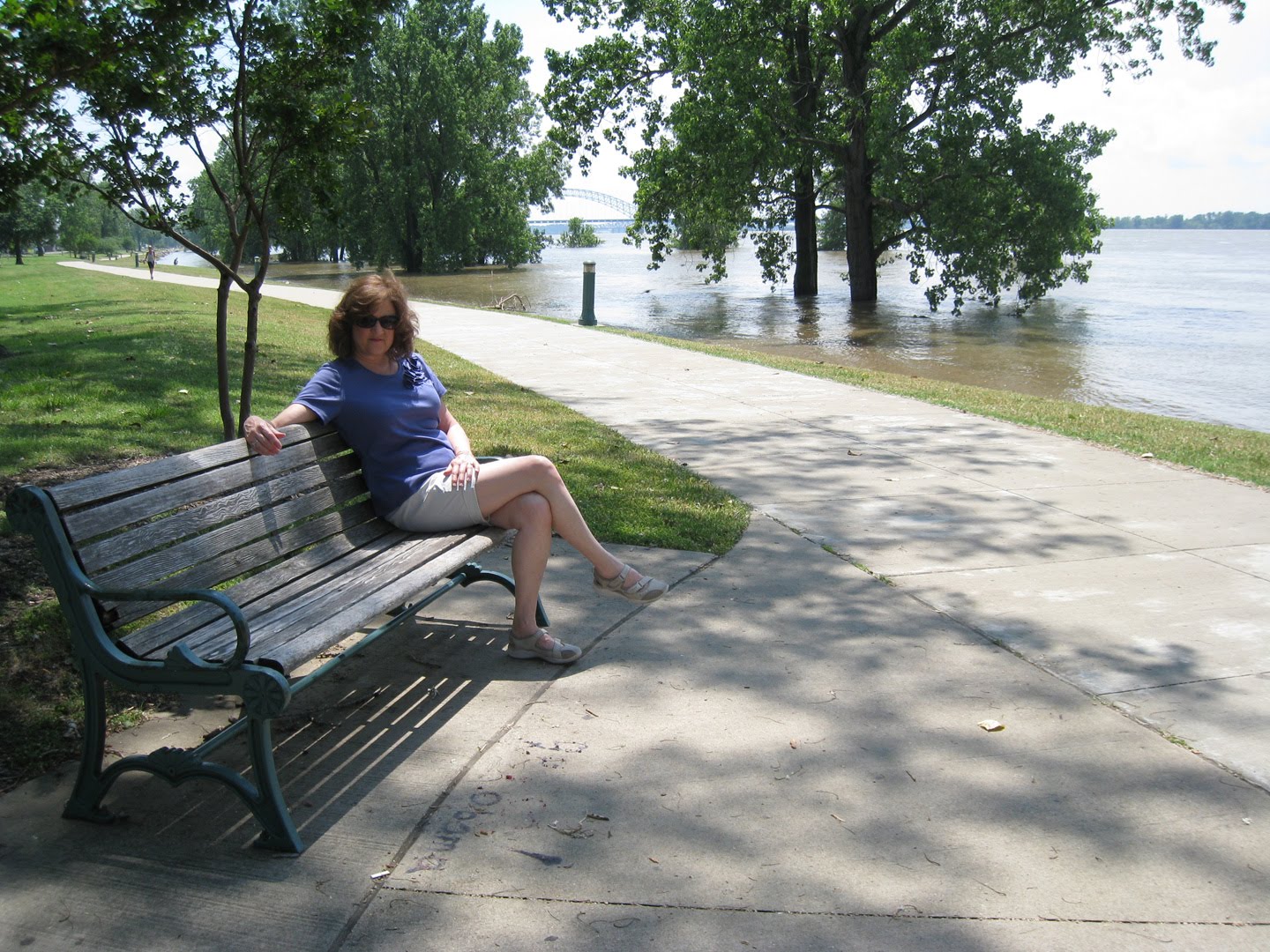
Today DH and I played tourist. We drove down to the river, which is about 20 miles from our home, and walked beside the submerged Mississippi River Greenbelt Park on Mud Island. The water actually crested on Tuesday morning (3 days ago) and has dropped about a foot since then. But it is still about 13 feet ABOVE flood stage!

There is a road that runs north and south on the island. The city of Memphis dumped/piled sand and gravel on the two lanes on the river side of this road, just in case the water rose enough to cover the road. The northern end of this road has been underwater for about a week, so presently, this southern end is the only access on and off the island, where many people live.

Above, I am standing on the driveway to one of the parking areas, which is submerged behind me.

Below, water, water everywhere!


Looking north along the ridge, you can see the driftwood that was deposited in previous days when the water was higher. Amazing how much stuff there is floating in that water!


The trees in the distance that are sticking up out of the water are pretty close to where the usual river bank is. Beyond that is the actual river channel.


The knit top I am wearing in these pictures is one that was recently made using my new drafting softward (Pattern Master Knits by Wild Ginger). I'll tell you more about this one as well as a couple of other tops in my next post.


Just trying to give a bit of perspective, but these pictures don't do any kind of justice to the magnitude of the flood. This water is lapping at the bank like the ocean on the beach! Farther toward the bridge (background), there were white caps!


We drove around to the Harbor side of the island to see how things looked. Above you can see the harbor between the island and the city of Memphis, as well as the bridge that provides access to Mud Island. The Pyramid is just on the other side of this bridge. Of course, with no knowledge of what this SHOULD look like, you probably don't appreciate how high this water is. But a few days ago, this parking lot was also flooded.


Here, you can see the debris on the side of the house, marking a previous water line from when the water crested. Normally, this home on the harbor side of the island is a bit farther from the water than it currently is!


These condos on the opposite side of the parking lot have placed a wall of sandbags all along the garages in an attempt to keep the homes dry. I hope it worked!

We enjoyed our walk, followed by lunch at Tugs, a restaurant in the Harbor Town area, also on the island.

Saturday, May 7, 2011

Happy Mother's Day!

Whether you ARE a mother, or have a mother, or have had a mother,
HAPPY MOTHER'S DAY!

I decided to go 'green' for Mom's gift this year:


I recycled a NIKE paper bag to use for the gift wrap, using bits of tissue paper and fabric to cover (somewhat) the Nike symbol in the lower corner. I wrapped the handle with fabric and added wooden beads to the ends.

For her gift, I decided to make a pair of pot holders, similar to the ones I made Joyce just a couple of weeks ago.


I like making gifts for people.


I tend to think about that person during the time that I am working.


Yes, I could go out and BUY a gift in much less time, but that is much less personal.


This time, I used the Insul-Bright that I had purchased at the quilt show in Paducah last month. Even though this 'batting' is supposed to prevent the heat from reaching your hand, you STILL have to add a second layer of cotton batting on the heat side of the holder, so the Insul-Bright will not come in contact with the hottest heat. I am wondering if just using cotton batting and flannel isn't just as good (?).


I layered one piece of the Insul-Brite and one layer of cotton batting between two layers of batik fabric. I had fused a leaf cut-out onto the top layer.


Before I stitched the layers together, I decided to satin stitch around each leaf first.
Then I put the layers together and used a 3-step straight stitch to do the veins.


Next, I stitched over the original leaf outlines again; this made the satin stitching fuller and quilted the layers together.


Then, like before, I cut this 'sandwich' to the desired shape and stitched a folded bias strip around the edge. I stopped the stitching just as I reached the original, so I could fold the underlayer over to the front.


To finish that cut end, I folded over about 3/4" and pressed it before folding it back in half.


Then I pressed that 1/4" seam allowance down.


Lastly, the loop extension was pressed in half...no raw edges.


While this worked really well at eliminating raw edges, it was a bear to sew across all those thicknesses to stitch down the loop!


But the end result turned out really well.

I think I might like these even better than the first ones I made!

Shhh! Don't tell Joyce...


Happy Mother's Day, Mom! :)


Free Hit Counter