Sunday, April 25, 2010

Back from Paducah

I'm baaaack! And I had a great time! This was my first visit to the quilt show in Paducah, and I hope it won't be my last. Paducah is a wonderful little town. I was quite impressed with the area around the convention center near the river...many quaint little shops and restaurants to visit, and everything was so pretty, with flowers blooming and all the landscaping looking quite well-attended! It felt 'safe'. Everyone we met was so helpful and friendly...nice.

My birthday fell during the days I was in Paducah, so my friends all helped to make it special. In addition to Vanessa and Marilyn (above), at the show, we met up with Etta (the one I went to Houston with last fall) and Charla and several of their friends and we all (10 of us) had dinner on my birthday at a wonderful little place called Patti's...
http://www.pattis-settlement.com/

Patti's serves bread baked in Terra cotta flower pots, along with strawberry butter! Yum! Plus, 2" thick pork chops are their specialty...although I got the salmon instead. There are white Christmas lights nestled with silk flowers and greenery along the ceilings and walls...I would hate to have to clean it, but it provided nice atmosphere!...hardwood floors and lace curtains, old oak furniture and antiques.

The waiters brought me a cherry cheesecake tart with a candle and everyone sang Happy Birthday to me! Ordinarily, I wouldn't have wanted that public singing, but what the heck...no one there knew me!...it was fun. The food was wonderful as was the company and the environment. It was a nice birthday!


The girls surprised me with this engagement calendar that everyone had signed...how cool!


This is what the inside looks like...a quilt picture on the left and seven days on the right...nice!


I'll take some pictures of my 'loot', too, to play show~n~tell!

Tuesday, April 20, 2010

No puzzle swap just yet...

Well, the puzzle swap had to be postponed. A family emergency has kept me out of town for the better parts of the last two weeks, so everyone agreed to wait until May to swap our puzzles. I'll be sure to post pictures when we do swap, though!

For now, I am planning a visit to the quilt show in Paducah, KY. I have never been before and am really looking forward to it! I don't know exactly what to expect...but I am open to being amazed! :)

More later...

Sunday, April 11, 2010

Puzzle swap

After visiting this blog, I suggested to my Fiber Arts group that some of us might wish to do a similar swap. Well, surprise, surprise...Fourteen ladies wanted to participate!


We set the first Monday of April as the day of the swap...this was decided back in January.
However, the community center where we meet decided to close that Monday (MLK day) so we will swap these tomorrow...on the 12th of April.


I finished my pieces in March, but needed to keep them secret until now!

Remember when the Carol Duvall Show was on HGTV? She had a variety of guests demonstrating a variety of crafts and usually there was SOMETHING on each show that I enjoyed and wanted to try.

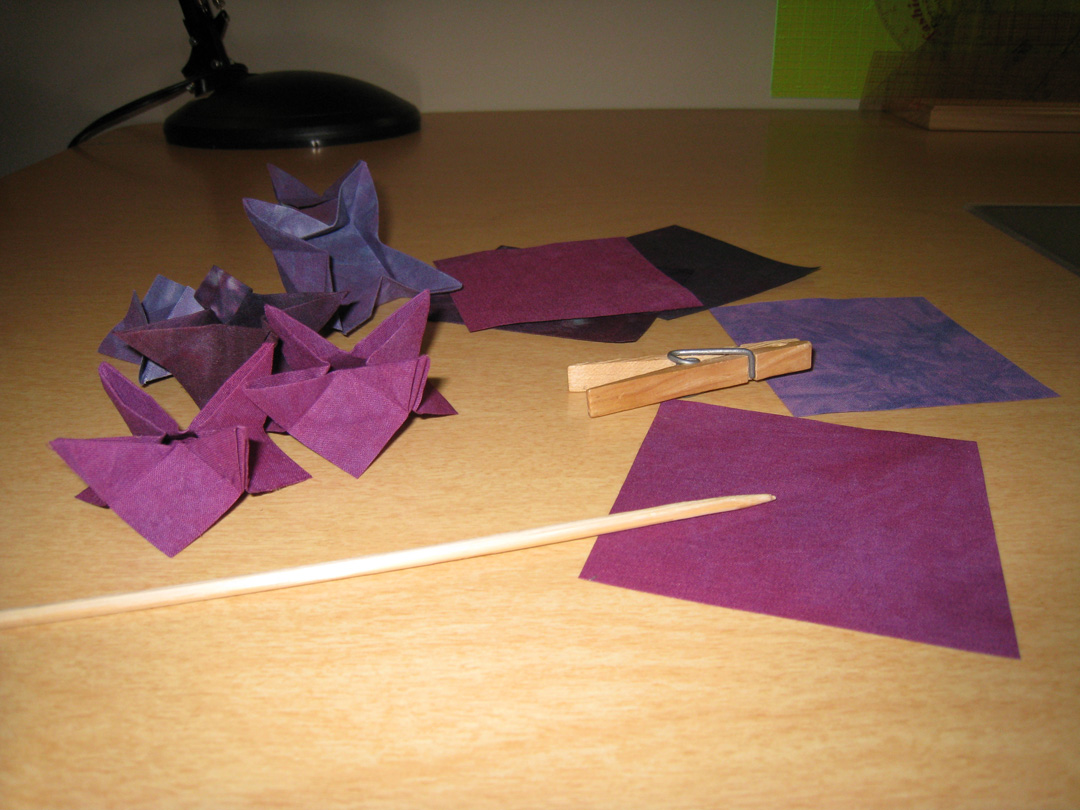
One of these demonstrations was origami using fabric.

The guest, Rebecca Wat, had published a book called Fantastic Fabric Folding and she demonstrated this one little flower. I followed along and folded a flower using a piece of paper.

I have kept it all these years. I decided THAT would be the theme of my puzzle pieces!


The first few flowers I made used the light pink fabric, and I used the iron to set the creases...but I decided the fabric would perform much better if it was starched...and my fingers would appreciate not getting burned! So I mixed up some boiled starch and drenched the remaining fabrics then ironed them flat and stiff.

Then I cut the fabric into squares. I wasn't particular about the size of the squares, making a variety to fit my scraps. After all, there weren't going to be sewn together, so the squares could be different sizes.

I folded the purples, pinks and magenta squares back and forth, just as I had done with the paper 'sample flower' I had saved all these years. It worked in fabric, too!

Next I rounded up some of the blue/green scraps of hand-dyed fabric left over from "Shoulda Putta Frog on it" (a.k.a. the Blue River Quilt) as well as some additional fabrics to use for the background.


Once the flowers were made, I attached the blue and green scraps 'log-cabin style' to the flower center. The object of the game was to get a background large enough to fit the puzzle piece template onto.


I layered these pieces onto some off-white felt and stitched the background...mostly stippling, although I experimented with other stitch patterns at first (the stippling looked best!). Then I used my puzzle template to mark these pieces. I had downloaded the puzzle piece used by this blog and shared it with the other participants in my group. One of the ladies in my group had laminated this and cut the pieces apart to provide each of us with a laminated puzzle piece to use as a template for drawing around...a nice help! Then I cut out the pieces using scissors. More than once I thought how nice a die-cut machine would be!


To give them a nice backing, I used Wonder Under to attach TWO layers of sew-in interfacing, then cut them into squares and painted them with acrylic paint. Once dry, I used the template to mark and cut these into puzzle shapes also. These were them paired with the pieced puzzles...I glue-basted them together, then stitched around the edges with variegated thread.

This is my final product!


I made 17 pieces, although I only needed 14. I wanted to have a few extra in case I messed up!


The hardest part was cutting these out. That is why I cut the top and backing separately...I had tried basting the top to the backing BEFORE cutting on 3 of them and was SO glad that I stopped to test the cutting before sewing them ALL together! It was easier to cut twice as many thinner ones than half as many thicker ones!


I have a variety of colors and flower sizes. The hand-dyed fabrics make nice things! I think I will have to start dying fabric...it is so much fun to use this stuff!


The tabs don't all interlock, but that is to be expected. Even if they did, once swapped, will mine interlock with those of others? Who knows! I will show you the result of the swap later...check back!


Sunday, March 28, 2010

The Blue River Quilt, FINAL Answer!

Yesterday I went to a warehouse sale being held nearby. Arlene Blackburn, a local fabric artist, has opened an internet fabric store, and she invited the local guild members to come by on Saturday when she opened to the public for a few hours. I did. And I bought several pieces! I first selected a bundle of fat quarters by Robert Kaufman...the Elementals Collection: Nature (lily pond colorway). Then I also pulled several bolts of batiks off the shelves and got a yard of each.


When I got home, I layed my new fabrics on the cutting table to admire them...and take a picture, of course. I walked into another room to get the camera, and as I returned to the sewing room, I had to laugh! I was struck by the similarity of the colors of the wonderful new fabrics I had just brought home and the quilt I have recently finished...they were practically the same!


I am not very good at cutting out pictures, so please excuse the jagged lines! But look at the similarity between these new batik fabrics and the hand dyed fabrics of my quilt (which hangs on the sewing room wall)!


Come to think of it, I am not sure I ever shared pictures of the *final*, final quilt. I know...I *thought* I had this finished several times, but truly, NOW it is finished!


The last time I showed this, it had lots of beads in the river in several curling swirls.

Well, I wasn't happy with the look, so I scattered even MORE beads on it, until it looked like it had blue chicken pox!

Not good...


To me, the swirls and sequins in the river were over-powering the quilt...that was all I could see!


I removed most of the river's swirls as well as the scattered beads and immediately liked it better! I slowly began to add bugle beads in a more orderly pattern. I wanted to create continuity between the orderliness of the beading at the top of the quilt and what was in the river. This is the finished product:


The final result still has beads, but not so much that that is all you see!


The placement of the beads was intended to represent reflections on the water.


There is still one swirl that is more heavily beaded, but the other swirls have more bugle beads than any other type of bead and are less heavily beaded.


This is the label on the back: I named this "Shoulda Putta Frog on it"...sort of tongue-in-cheek! Over the many months that I have worked on this, one of the girls in my Monday group kept asking where the frog was...so I put one on the back. Plus, "The Blue River Quilt" sounds so boring..."Shoulda Putta Frog on it" sounds more intriguing...at least for NOW. Having just finished "Shoulda Putta Ring on it", this can be part of my "shoulda putta" series!


Of course, in years to come, this name will no make sense to anyone.

Saturday, March 27, 2010

Red and 'just wrong' again!

This week at my local quilt guild meeting, we worked on charity quilts...basically, we had a 'sit and sew'. I brought my machine in and was given fabric to sew on. My table's quilt wasn't finished at the meeting, so I brought it home to finish. This is the result.


This is one of those "quilt as you go" quilts...basically, once it is assembled, you are done.

The fabric was pre-cut into 13" squares, then stacked into sets of 3...two 'fashion fabrics' and a 'batting'. The FF's are placed right sides together, then the 'batting' is placed on the bottom of the stack.

Instead of traditional (fluffy) quilt batting, we were using cotton flannel. However, the set of squares brought to me didn't even have flannel...the inside layer was just a thin cotton, like white muslin.

A large circle was drawn on the back/wrong side of the top FF square. I was to sew around this circle, then someone else was trimming around the circle of stitching and making a small slash in the top layer (only), then turning it right side out. Then another lady at our table would press these circles. Next a square template was used to draw lines on the circle so they could be sewn together.

These circles were sewn together into rows, then the rows were assembled into a quilt.

Because some of the backing fabrics were the same as the top fabric, there was very little definition of the 'pattern' that is to be the result of this technique. In order to TRY to create some definition, I had used a blanket stitch when stitching down the 'flaps' that are created when the circles are sewn together...basically, this is a "faux-cathedral window" quilt. The blanket stitch was an after-thought, so the quilt was half-assembled when I started this.

I quickly realized that it would be SO much easier to do some of the blanket stitching when the pieces were still in the 'row' stage.


In the picture below you can see that I have already done the blanket stitching on the last row and it is ready to be attached to the quilt. This way, once the 'row' seam is stitched, it can then be blanket stitched across the quilt without having to go in all four directions around the circles.


Also in that picture below you can see a tiny slit in the FF near the lower edge of the circle on the right. Well, THAT is a problem. Yes, that is the slit that was used to turn the circle right side out. But this is the LAST ROW...there is nothing to be sewn to the botton edge, so that area will not be folded over like on other rows. That circle should have been rotated 90 degrees when that row was sewn, so that the slit was covered in the first stage of sewing.


Too bad I didn't catch it until that row had been assembled AND sewn onto the quilt! This was the last row...I was almost finished...ready to blanket-stitch that last seam...and suddenly, there it is. A slit. Right there on the corner circle.


Dammit.


And here's the deal: After sewing these circles together to make a 'row', I would lay the row on the table and place a ruler across the top of the seams and draw a line which would be the stitching line for assembling the row to the others. And I used a SHARPIE to draw that line. It wouldn't show after the flap was folded and stitched.


So that corner circle had a slit in the bottom edge and a permanent black line across the top edge. It couldn't be rotated and reused, because the corner needed two ADJACENT edges to be 'blemish-free".


Great.

So I had to rip and remove that last row, then also rip out the blanket stitching around-- NOT ONLY the corner circle, but the next-to-corner circle also--so I could switch their postions, placing the corner circle toward the middle of the row where it wouldn't need two adjacent blemish-free sides. This added hours to the construction time!

But it is now finished.


Overall, I am not fond of this thing. The charity to receive the quilts this time is a hospice center. Well, to me, this quilt looks very funereal...black and red roses?


How cheerful.


The only way it could possible be more macabre is to perhaps include some of those DAY OF THE DEAD skeletons wearing sombreros!


Or perhaps this:


But fortunately, there are no skulls or skeletons on this. There are red roses, though...


I dunno...it just doesn't say "hospice" to me!


I did learn a few things when making this quilt...for one thing, the circle they drew on the quilt for me to stitch on should have been treated as a CUTTING line instead of a STITCHING line. I should have stitched 1/4" INSIDE that circle, because the square template that was provided was smaller than the finished circle. This means that the flaps are not all the same size...the vertical ones are larger than the horizontal ones. No big deal, but still....


Pressing is very important. The circles need to be well-pressed before assembling.


And when sewing those rows, be sure to include the slit side in the first stage of construction, so there will be no problems later.


Ackkk! Today I was going over this finished quilt with a lint brush, to remove stray threads, etc, and what did I find? There is a little 'snip' on the back side of one circle! Judging by the location, it looks like it might have been snipped when they were creating the 'slash' on the opposite side for turning the circles right side out. It is small...less than 1/4"...but it is 'there'. I have put some Fray check on it, but I can't leave it this way. I'll have to stitch over it somehow. Either a bar-tack kind of thing, or possible some hand stitching...although, truly, the machine bar-tack will look less like a repair, because my handwork isn't great. I think this would be a good time to have some of that Bo-Nash powder...

Thursday, March 25, 2010

Red and Wrong

The sky was looking a bit ominous, so I went outside and picked a small bouquet of daffodils from my yard. I wish your monitor was scratch and sniff...they smell so good! They smell like Spring...especially when you consider that I can also smell rain through the open window beside me.

Rain? Yep. We just had a short rainshower that followed the brief HAIL STORM that just suddenly occurred!!! And this was less than 20 minutes after I picked these flowers!!! I hope it didn't harm the ones I left behind.

Strong wind and hail?
Good grief...in like a lamb, out like a lion?


I gave a bit more thought to HOW to eliminate the excess width that is created when one rotates part of the bust dart to the CF area to create gathers. This is kinda what I was thinking: Using my previous pattern, what if I just 'shifted' the width of the above-bust area medially, until the excess is gone? Here's a picture to show what I mean.

On the left is my pattern with the excess width (little triangle pointing downward at CF/neck). The next image with green lines indicates the original width of that area, before the excess was added. Third, those green lines are 'shifted' to the right until they touch the CF line. Lastly, the pink line indicates the NEW sewing line, which is basically removing the excess at the side of that section...the yoke seam.


I decided I would try this on the next pattern. But I also decided to do a few other things differently, too! I would make an awful scientist, because I introduce too many variables in my experiments!

Ok, on this knock-off of the Jalie 2794 (take three), I again drew guidelines:
  • blue = grainline.
  • green = future locations of dart rotation (directly opposite BP and toward lower ah).

Plus, I located a point on the side seam...this time, it was 1.5" below the underarm (before it was 2.5"). I also drew an ARC (orange) to connect the new point on the sideseam with the neckline to create the yoke shape.

Then I removed the yoke area.

I selected everything above the bust level (green) and rotated counter-clockwise to close ONE FOURTH of the bust dart (before, I put HALF of the dart into CF). This put less dart into the CF area and created less excess width to remove. Remember, before, I was not thrilled with the amount of gathering at the center front, so I was hoping this would be just right.

Next I selected the area in bold black and rotated CCW to close the remaining bust dart, which opened a dart in the yoke seam. THis one is larger than on the previous one because it is 3/4 of the dart (as opposed to being only half before).


Now it was time to 'shift' the upper section medially to eliminate that excess width at the front. I selected the neck and upper section of the yoke seam (light blue) and moved it toward the middle, such that the length of the seams did not change. Then I redrew the ARC that is the yoke seam, and Voila! a new pattern to try.

Now here is where I messed up. Remember that top I made last fall? The NO DART one from the red textured knit? Well, I hate that top and never wear it. I decided to rip it apart and recut it from this pattern. I dug until I found the remnants of that piece...not much, but enough to cut out the two new yoke pieces and a band for the neckline.


The new pieces were easily cut from the scraps of the first top.
Oh! This time (after this photo was taken) I re-cut the band to be only 1.5" wide, whereas before, it was cut 2" wide. I think I like the narrower band on the top...but wider was ok, too.
Either way, when the top is finished, I have to miter the band at the center of the V...i.e., sew across the folded band at a 45 degree angle to create a 'v'.


I left the very bottom of the sideseams unripped, to leave the hem as is...hoping to avoid one step in completion of the new top.


Then I layed the patterns onto the old top. Below, you can see the relationship of the YOKE pattern to the FRONT pattern...although the yoke WILL NOT be cut from this piece (it was cut from the scraps, remember?). But this clearly shows where the bust dart went.


When I carefully positioned the new patterns onto the previously cut top, I coud see that the old FRONT pieces were a little bit too narrow right where the yoke seam meets the side seam. I decided that I would go ahead and cut it anyway...I had ruined the old top by ripping it apart anyway, so if it turned out too tight, I would just give it away. And FYI, I had drafted this NEW pattern with only ONE inch bust ease this time; the leopard top had 2" bust ease. THis pattern had only 1" bust ease, and the fabric STILL was not wide enough...so I would actually end up with even less! But I proceeded.
Here, you can see the front pattern piece overlayed onto the now-finished top. The end of the ruler is aligned with the side seam of the top...it is a good 1" smaller than the pattern. This means the front of this top is 2" narrower than the pattern calls for! I spread out some of the gathers that should have been the bust dart to make the yoke seam longer to help make up for the lack...that enabled me to sew on the yoke, which was the correct width, but it didn't add any front width BELOW the yoke seam, and THAT is where it was needed!


The old sleeves were used as-is, because I couldn't make them any larger! ("what?" you say!)
I know...I thought the sleeves would be wide enough to reuse, but it turns out the back was at least 3/4" too small...so I just sewed them in as is. This means there was NO ease in the cap seam...and possibly, the cap seam was smaller than the armhole.
Oh! The back neck on the old top was wider than the back neck on the new pattern...one of the very areas I wanted to change! I could narrow it some, but not enough without making the top too short in length...so I decided to use the band to pull it in (by stretching the band in that area when sewing it on). But I probably stretched the band too much in the front neck area, too...the neck is sort of being pulled upward.
So, between the neck pulling the front up, and the sleeves pulling in the bodice, and the front width being inadequate, this thing didn't have a chance!
Lemonade.

Overall, the fit is not as bad as it ought to be, but it is tighter than I desire. The pattern, though, is probably good...if only it had been actually USED correctly!!!


Although the front neck depth was increased this time, it is hard to tell it, because the band is pulling up the front (didn't I learn not to do that on the FIRST top?).
Also, I like that the amount of front gathers is less than before. THIS TIME, I only gathered from bust level UPWARD...but not below the bust (so I didn't use that point that was located on the CF that was below the bust level). I actually think I could have put a full HALF of the bust dart into the CF after all, since I removed the excess width AND since I only gathered ABOVE the bust level.
The back isn't awful...it would be fine if the skimpy front wasn't pulling it out of place! But because the front was too narrow (and I used it anyway!), it pulls the back tighter and shows 'bra bulges' (what? Surely *you* don't have those!? Sigh. Yes I do.).
The shoulders are MUCH better this time. I used the NO BACK DART setting and used the ARMHOLE SHAPE TOOLS to reshape the armhole to be much more of a slant. I have found that drafting WITH a shoulder dart produces a smaller back half of the sleeve than drafting WITHOUT a shoulder dart. I have been trying FOR YEARS to get adequate back width (driving room) in my garments, and the advice given was always 'increase the BACK SHOULDER WIDTH", which increases the size of the bk shoulder dart. My friend, Heidi Jung, assures me that I only need a 3/8" width shoulder dart...and to get that, I just have to use a BSW measurement that is .75" larger than the FRONT SHOULDER WIDTH measurement. It is the ARMHOLE SHAPE TOOLS that enable me to increase the width at the lower back armhole without using a large back shoulder dart. The AH shape tool seems to work better now than when it was first introduced (ten years ago?)...when it created large circles and jinks with only a few clicks.
Oh, I reduced my NECK CIRCUMFERENCE MEASUREMENT to 13", even though it measures more than that. I don't need to make it larger (to control the size of the back shoulder dart) if I am not using a large BSW and NOT getting a large shoulder dart!
I know this works in a knit now...I just have to prove it in a woven!

Here is my STYLE SHEET info:

Garment Type: Blouse
Style: Blouse
Closure: No Closure
Front Neckline: Square
Back Neckline: Jewel
Hemline Sweep: Straight
Hemline Shape: Straight
Front Darts: Side
Back Darts: No Darts
Sideseam Shape: Fitted

Front Waist Darts: 1 ...didnt' sew these!
Back Waist Darts: 1

Front Neckline Depth: 6
Back Neckline Depth: 0.75
Neckline Width: 0.5 ***WIDER than last time...better.
Neckline Point: 0
Front Neckline Shape Up: 2.7 clicks
Front Neckline Shape Right: -2.2 clicks

Armhole Depth: -0.75
Dart Override: 0

Side/Arm Point: -1
Side/Waist Point: 0.75
Side/Hip Point: 0

Cf/Extension: 0
Cb/Extension: 0

Shoulder Pad: 0
Shoulder Point: 0

Finished Cb/Hem Length: 24
Hip Depth: 8

Bust Pt Vertical: 10.5
Bust Pt Horizontal: 5
Upper Front Dart Length: 1.25
Upper Back Dart Length: 0
Lower Front Dart Length: 8
Lower Back Dart Length: 6.5
Back Shoulder Dart Length: 3.5 ***used NO DART option


Sleeve Style: Set In
Sleeve Underarm Seam: Tapered
Sleeve Hemline Shape: Straight
Sleeve Length: Wrist
Sleeve Cap Ease: 0.35**********
Sleeve Underarm Length: 20 ***used sleeves from original top, so these don't apply
Sleeve Overarm Length: 24.755 *****
Sleeve Hem Circumference: 9.5
Sleeve Elbow Depth: 8
Sleeve Elbow Circum.: 13
Sleeve Cap Height Adj: -0.75

Front Armhole Shape Down: -1 clicks
Back Armhole Shape Up: 1 clicks ***this is TEN clicks...and is the key to using NO BACK DART.
Back Armhole Shape Right: 0.2 clicks ***this is outward.

Chest Ease: 1
Waist Ease: 3
Hip Ease: 3.5

Chest Circumference: 41.5
Back Shoulder Width: 17.5 ***used NO DART...This # will be reduced to 15.75" next time.
Neck Circumference: 13
Natural Waist: 34
Hip Circumference: 42
Crotch Length: 29
Height: 66
Weight: 161
Bra Cup Size: D
Center Front Length: 14.875
Front Shoulder Width: 15
Front Shoulder Slope: 18.125
Shoulder Length: 5
Center Back Length: 16.5
Back Shoulder Slope: 18.125
Bicep Circumference: 12

Monday, March 15, 2010

Take two, continued


I forgot to give details about the 'band' that I used. I cut it 2" wide of self-fabric and folded/pressed it in half lengthwise. I cut one length for the top of the front pattern (neck edge) and another longer piece to go around the yokes and back neck.


I marked notches so that when I sewed it to the yoke edge, it would be applied 1:1. However, I found that I needed to stretch it around the neck area to keep it from sticking out.

Originally, the band was cut the same length as the total of the neck and yoke seam length, but later I reduced that length by 2", stretching the band around the back neck and just slightly on each side of the front neck.

Here you can see the inside of my top...the center front gathering was achieved using by a piece of elastic...I did a straight stitch down the middle of the elastic when it was stretched.
 
Free Hit Counter